
What Good On-Site Fuel Control Looks Like
A tank that sits behind the yard gate can quietly drain profit for months before anyone proves where the loss is happening. The usual signs are familiar – fuel variance that never quite reconciles, handwritten logs with gaps, PINs shared between drivers, and month-end questions nobody can answer with confidence. For fleet operators, airports, municipal depots and mobile fuelling teams, that is not just an admin problem. It is a control problem.
Why on site fuel dispensing management matters
On site fuel dispensing management is the discipline of controlling who can dispense, what they can access, how much they take, and how every transaction is recorded and reconciled. When it is done properly, every dispense event is tied to a known person, asset or job, and the data is available quickly enough to act on.
That matters because fuel is one of the easiest operational costs to lose sight of. Unlike a broken vehicle, it rarely announces itself. Small losses spread across multiple drivers, pumps or locations often look like normal usage until a finance review or stock check exposes the gap. By then, the business has already paid for the waste, theft or error.
A good system brings control back to the point of dispense. It stops unauthorised use before it happens, creates an auditable record automatically, and gives operations and finance the same version of the truth.
What strong on site fuel dispensing management includes
The best systems do not start with reporting. They start with access control.
If a pump can be used without verified authorisation, the rest of the process is already compromised. Cards get shared. Keys go missing. Codes get passed around. Manual logs are completed after the fact, often from memory. That creates exactly the conditions where shrinkage, poor attribution and stock discrepancies thrive.
Secure user authorisation at the pump
A modern approach verifies the user before fuel flows. In practical terms, that means the pump is locked down until an authorised person requests access and the system confirms their permissions. This can be managed through a smartphone-based workflow rather than a dedicated pedestal or card-only set-up.
That shift matters more than it first appears. It reduces hardware complexity on site, shortens installation time and makes it far easier to add, remove or change user permissions across multiple locations. If a driver leaves, changes role or loses access, you should be able to deauthorise them immediately rather than waiting for cards to be collected or local systems to be updated.
Real-time transaction capture
The second requirement is automatic transaction logging. Every dispense should generate a digital record with the key details attached – user identity, asset, date, time, location and volume. If the business also dispenses oils, DEF or other fluids, the same principle applies.
This is where many legacy arrangements fall short. They may collect some data, but not consistently, not in real time, or not in a format that supports fast reconciliation. Operations need visibility for control. Finance needs clean records for auditability. Maintenance teams need usable data to spot anomalies in asset consumption. If any of those groups are relying on patched-together spreadsheets, the system is costing more than it saves.
Cloud visibility across fixed and mobile sites
For fleets with more than one depot, or any mobile fuelling operation, central visibility is not a luxury. It is the difference between managing by exception and chasing paperwork.
Cloud-connected dispensing management allows supervisors and decision-makers to review activity across stationary tanks and mobile fuel vehicles from one place. That creates consistency. It also reduces the usual lag between what happened on site and what head office can verify.
There is a practical benefit here for growing fleets. A system that works for one yard but becomes awkward at three or five sites is not really scalable. Centralised controls, live updates and standardised reporting help avoid that trap.
Where fleets lose money without proper controls
Most losses are not dramatic. They are repetitive.
A shared code used on the night shift. A mobile fuelling unit with no dependable user attribution. A tank dip that never quite matches recorded usage. A manager who has to wait until month-end to discover an issue. None of these sounds major in isolation. Together, they create persistent leakage.
Poor on site fuel dispensing management also adds hidden labour cost. Someone has to decipher paper records, compare deliveries with usage, chase missing information and explain variances. Even when no theft is involved, the business still pays for weak process through admin time, delayed decisions and poor confidence in reporting.
This is why accountability should be built into the fuelling workflow itself. If the control only begins in the back office, it begins too late.
Why old pedestal systems are no longer the default
Traditional pedestal-based systems were once the expected answer for controlled fuel access. In some environments, they still have a place. But they often bring more infrastructure, more maintenance points and more cost than many fleets need.
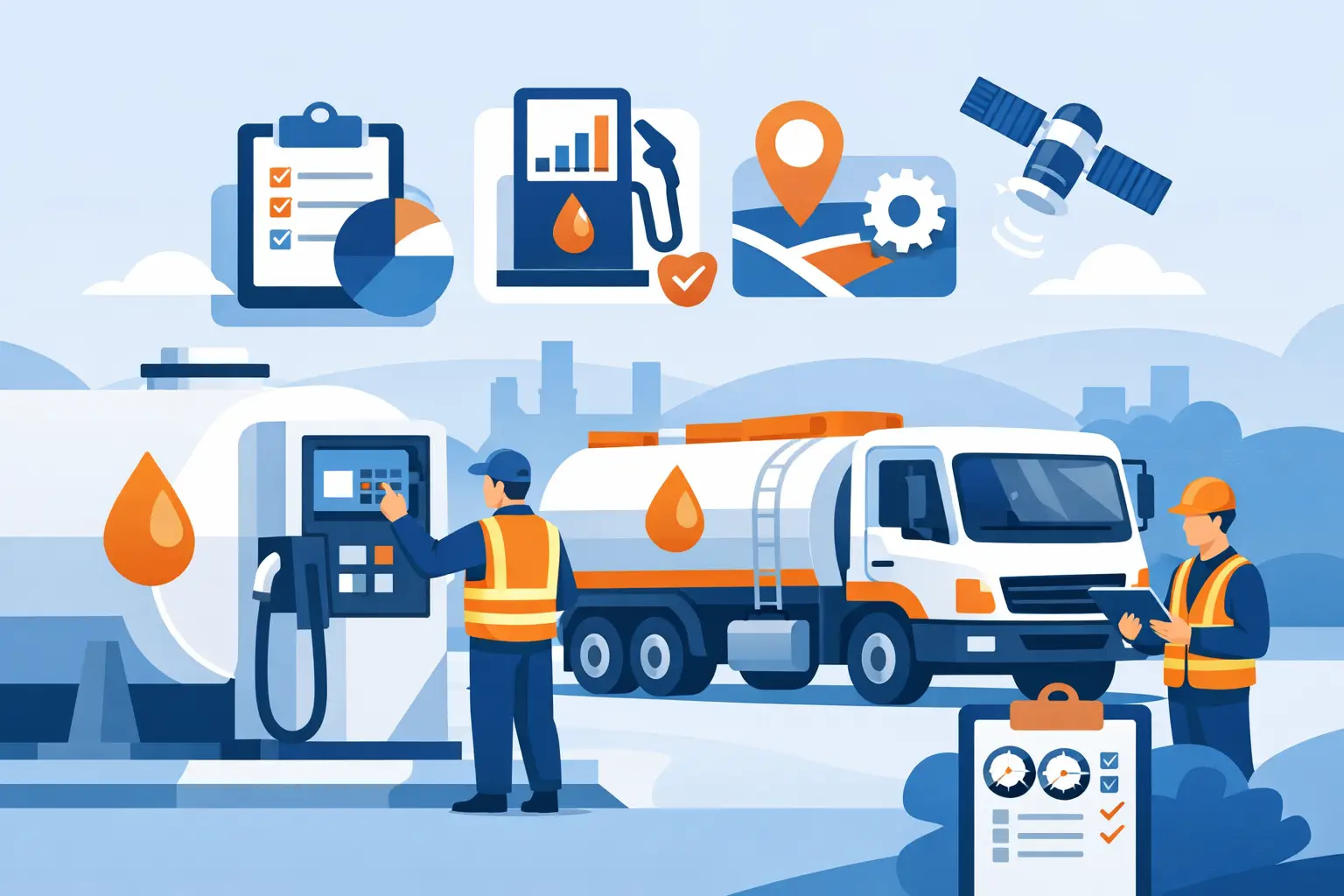
A simpler model now exists. With rugged hardware at the pump, smartphone-based authorisation and cloud-connected transaction logging, operators can get the control they want without the same installation burden. That tends to lower total cost of ownership and reduce site complexity.
The trade-off is straightforward. Some businesses are comfortable with the older architecture because it is familiar. Familiarity, however, is not the same as efficiency. If the priority is lower maintenance, faster deployment and easier permission management across locations, newer approaches are often the better fit.
Choosing the right system for your operation
The right solution depends on how and where you dispense.
A single-site fleet with one bulk tank may care most about stopping unauthorised use and eliminating paper logs. A multi-site operator may prioritise central reporting and instant user management. An airport, council depot or mobile fuel provider may need stronger controls across mixed asset types and more demanding audit requirements.
Questions worth asking
Before choosing a system, look past headline features and ask how control actually works day to day. Can you authorise and deauthorise users instantly? Does every transaction sync to the cloud automatically? Can the same platform cover both fixed tanks and mobile fuelling units? How much hardware needs to be installed and maintained on site? And how easy is it for finance to reconcile stock, usage and deliveries without manual intervention?
These questions matter because a system that looks capable in a demo can still create friction in daily use. If drivers avoid it, if managers cannot trust the data, or if support is slow when something goes wrong, value erodes quickly.
The operational payoff of doing it properly
When on site fuel dispensing management is set up well, the gains show up across departments.
Operations get control at the moment of dispense, not after the fact. Fleet managers can see usage patterns sooner and investigate exceptions before they become recurring losses. Maintenance teams can identify unusual consumption against specific vehicles or equipment. Finance and procurement gain cleaner records, faster reconciliation and a stronger audit trail.
There is also a cultural effect. When users know dispensing is tied to their identity and recorded automatically, standards improve. That does not mean every discrepancy disappears. It means the business can separate genuine operational issues from poor process and unauthorised use.
For many fleets, cost matters just as much as control. That is why lower-complexity, cloud-connected systems are gaining ground. If you can reduce shrinkage, cut admin time and avoid the heavy upkeep of older infrastructure, the return is not theoretical. It appears in labour, loss prevention and decision-making speed.
Manage Every Drop focuses on exactly that outcome – securing each dispense, recording it in real time and giving fleets a practical, lower-maintenance way to account for every litre.
The standard has changed
Fleet operators no longer need to accept delayed records, shared access methods and reconciliation that depends on crossed fingers. The standard now is clear: secure authorisation, immediate transaction capture, cloud visibility and accountability that holds up under scrutiny.
If your current set-up cannot tell you who dispensed what, into which asset, at what time, and whether it matches your stock position, then the issue is not just visibility. It is control. And once control is tightened at the pump, a great many downstream problems become far easier to manage.


Post a comment