



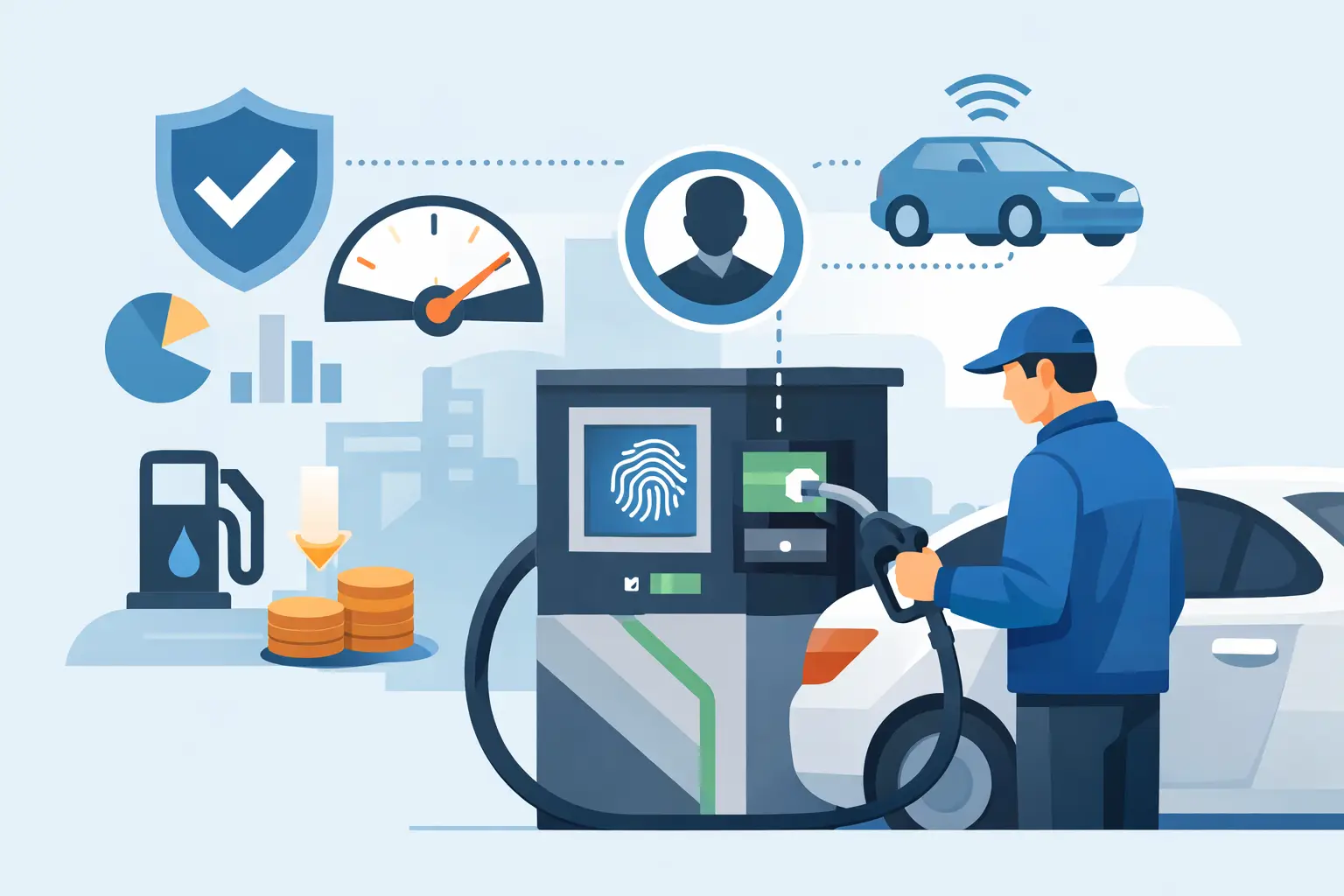
Driver ID Fuel Dispensing That Cuts Loss
A fuel pump that starts for anyone with a key, a code scribbled on paper, or a shared tag is not a control system. It is a leakage point. Driver id fuel dispensing changes that by tying every litre issued to a verified person, a specific vehicle or asset, a time, a location and a transaction record you can actually trust.
For fleet managers, operations leads and finance teams, that shift matters because fuel loss rarely appears as one dramatic incident. It shows up as small unexplained variances, delayed reconciliation, manual logs with gaps, and too many exceptions that nobody can confidently resolve. When dispensing is linked to driver identity at the point of issue, accountability stops being retrospective and starts at the pump.
What driver id fuel dispensing actually does
At its simplest, driver id fuel dispensing means a user must be identified and authorised before fuel can be dispensed. That identification might happen through a smartphone, PIN, RFID credential or another approved method, but the principle is the same: no identity, no fuel.
That sounds straightforward, but the real value is in what happens behind the authorisation. The system records who dispensed, what was dispensed, when it happened, where it happened and, in better systems, which vehicle, tank or asset received it. Instead of a loose chain of handwritten tickets and delayed data entry, you get a live transaction trail.
For operators with multiple depots, mobile bowsers or mixed fleets, this is where the operational advantage becomes clear. You are not just controlling access. You are creating an auditable fuel record at the exact moment fuel leaves storage.
Why driver id fuel dispensing matters more than locks and keys
Physical security still matters, of course. Tanks need to be protected, pumps need to be secured and equipment needs to withstand harsh sites. But locks, keys and static credentials only answer one question: could someone access the pump? They do not answer the more useful question: should this person have been able to fuel this asset right now?
That distinction is where many sites fall short. A shared key fob or a staff PIN passed between drivers creates the appearance of control without real accountability. If fuel goes missing, the records do not stand up. If a contractor fuels the wrong unit, the exception often surfaces days later. If a member of staff leaves, removing access may depend on collecting physical credentials and updating local hardware.
A properly designed driver id fuel dispensing system closes those gaps. Permissions can be granted or revoked quickly. Transactions are captured automatically. Supervisors do not need to chase paper trails to piece together what happened.
The operational case for driver id fuel dispensing
Fuel is one of the largest controllable costs in fleet operations, so even small percentage improvements matter. The issue is not only theft, though that is often the first concern. It is also misfuelling, unauthorised use, after-hours dispensing, data entry errors and the admin time required to reconcile activity across sites.
When each dispense is tied to a driver identity, several things improve at once. First, unauthorised use becomes far harder because access depends on approval, not assumption. Second, reconciliation becomes faster because transactions are already logged digitally. Third, exception management improves because managers can review activity by user, asset, site or time period without waiting for end-of-month paperwork.
There is also a behaviour effect that should not be ignored. When drivers know dispensing is accurately attributed, compliance tends to improve. The same applies to supervisors and contractors. Good systems reduce friction for authorised users, but they also remove ambiguity. People know the standard, and the standard is enforced by the system rather than by memory.
Where traditional systems often create more work
Many legacy fuel management set-ups were built around pedestal hardware, fixed terminals and site-specific infrastructure. They can work, but they often carry higher installation costs, more maintenance points and less flexibility when fleets grow or operating patterns change.
That becomes a problem when organisations need to add mobile fuelling, temporary sites or remote locations without building the same heavy hardware footprint each time. It also becomes a problem when user permissions need to be updated quickly across multiple sites. If authorisation sits locally rather than in the cloud, changes can lag behind operational reality.
Driver id fuel dispensing works best when identity control, transaction capture and reporting sit within one connected system. That reduces duplicate admin and gives decision-makers one source of truth. It also means software changes and user updates can be managed centrally rather than site by site.
What to look for in a driver id fuel dispensing system
Not every solution that claims to identify users delivers the same level of control. The difference usually comes down to how access is authorised, how quickly records are available and how much manual intervention is still needed after each transaction.
A strong system should make authorisation simple for the driver but strict in the background. It should support instant user activation and deactivation, because delayed permissions are a security risk. It should create cloud-based transaction records in real time or near real time, so managers are not working from stale information. It should also handle both fixed tanks and mobile fuelling assets without forcing separate workflows.
Reliability matters just as much as features. Fuel sites are not office environments. Hardware must cope with weather, vibration and hard use. If a system is fragile or overly complex, staff will create workarounds, and workarounds are where accountability starts to erode.
Driver ID fuel dispensing and compliance
Compliance pressure varies by sector, but record quality matters across the board. Whether the issue is internal policy, environmental accountability, cost allocation or audit readiness, weak fuel records create risk. If you cannot show who took fuel, from where and for what purpose, you are left defending assumptions.
Driver ID fuel dispensing strengthens compliance by making each transaction attributable and time-stamped. That helps with internal controls, but it also helps when finance teams need confidence in cost coding and inventory movements. If there is a discrepancy between physical stock and issued volume, you have a defensible transaction history to investigate.
It also supports safer operations. When access is linked to authorised users, it is easier to ensure only trained personnel can dispense certain fuels or operate specific equipment. That does not replace site procedures, but it does reinforce them in a practical way.
The mobile fuelling question
This is where many operators still accept too much compromise. A depot may have reasonable controls, but once fuel is dispensed from a mobile unit, records often become patchy again. Paper logs reappear, time delays creep in and verification depends on someone remembering to complete the process properly.
A modern approach should apply the same identity and transaction standards to mobile fuelling as it does to a fixed site. If the control model changes whenever fuel leaves the yard, the weak point has simply moved. For airports, construction support fleets, field service operations and lorry operators with remote assets, consistency across mobile and stationary dispensing is not a nice extra. It is the whole point.
This is one reason many operators are moving away from heavier legacy infrastructure and towards cloud-connected systems such as those deployed by Manage Every Drop. The priority is not technology for its own sake. It is getting secure authorisation, live records and lower maintenance across every dispensing scenario.
It depends on how your operation runs
There is no single best set-up for every fleet. A smaller operator with one site may focus first on stopping casual fuel loss and replacing paper logs. A multi-site fleet may care more about centralised permissions, standardised reporting and cross-location oversight. An operation with mobile bowsers may place the highest value on applying the same controls in the field as at the depot.
That is why the right question is not, do we need more control? Most organisations already know they do. The better question is where your current process breaks down. If disputes over fuel use keep surfacing, if leavers retain access too long, if stock reconciliation drags on, or if exceptions cannot be investigated quickly, driver id fuel dispensing is no longer a technical upgrade. It is an operational correction.
The strongest systems do more than block unauthorised dispensing. They reduce admin, improve visibility and give finance, operations and maintenance teams confidence that the data reflects reality. When every dispense starts with verified identity and ends with a clean digital record, control stops being a policy on paper and becomes part of the way the site runs every day.
If fuel matters to your cost base, your uptime and your audit trail, identity at the pump is not an extra layer. It is the standard that keeps every litre accountable.



Post a comment