



Driver ID Based Fuel Dispensing Explained
A fuel tank can look fully under control right up to the moment the numbers stop adding up. The issue is rarely the pump itself. It is who accessed it, when they did it, what they took, and whether anyone can prove the transaction afterwards. That is where driver id based fuel dispensing changes the standard. Instead of treating fuelling as a loosely supervised task, it ties every dispense event to a verified person, creating clear accountability at the point where loss usually starts.
For fleet operators, airports, municipal depots and mobile fuelling teams, that shift matters. Fuel is one of the largest controllable operating costs in the business. Yet many sites still rely on keys, PINs shared between staff, handwritten logs or standalone terminals that create more admin than assurance. If your goal is to reduce shrinkage, tighten reconciliation and keep sites moving without adding hardware complexity, identity-based control deserves a close look.
What driver id based fuel dispensing actually means
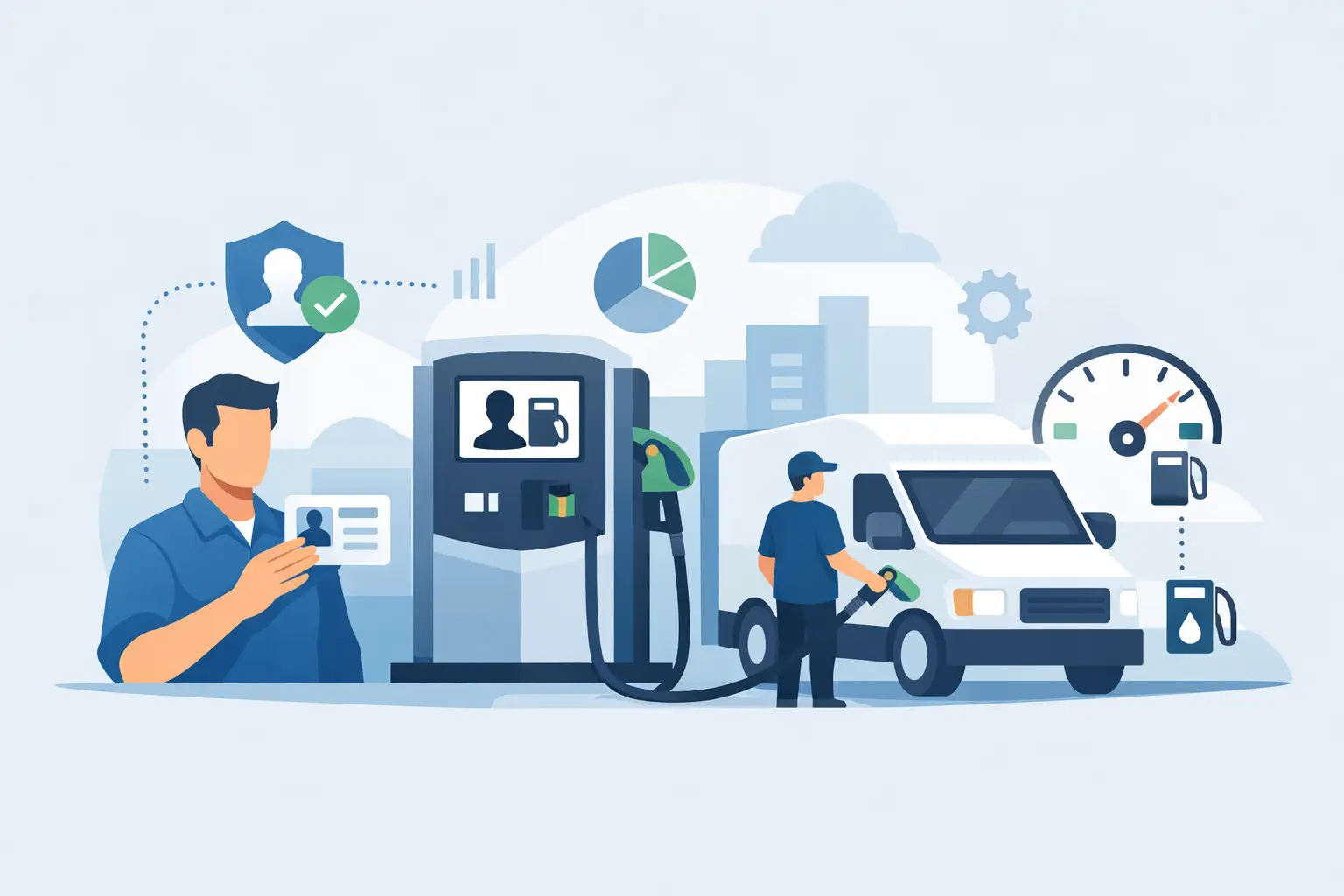
At its simplest, driver id based fuel dispensing means the pump will only activate once an authorised driver has identified themselves. That identity check can happen in different ways, but the principle is consistent: no valid user, no fuel.
The real value is not only access control. It is transaction certainty. Once each dispense is attached to a named, authorised driver, you move from guesswork to records you can audit. You know who dispensed, where it happened, when it happened, what asset was involved and how much product left the tank. That is a very different operational position from checking paper sheets at the end of the week and hoping they line up with inventory.
For organisations with multiple depots, mixed fleets or mobile fuelling operations, the effect compounds quickly. One standard for authorisation and one trail of records across fixed and mobile sites means less fragmentation and fewer blind spots.
Why fleets are moving towards driver id based fuel dispensing
The old model leaves too many gaps. A shared card can be borrowed. A key can be copied. A PIN can be passed around the yard in a few hours. Even where there is no bad intent, weak controls create avoidable errors. Wrong vehicle entries, missed logs, unrecorded top-ups and delayed reconciliation all undermine confidence in the numbers.
Driver ID changes behaviour because it removes ambiguity. Staff know each transaction is tied to their identity. Managers no longer have to infer responsibility after the fact. Finance teams are not left chasing paperwork to understand variances. Operations teams get faster answers when something looks off.
There is also a practical cost argument. Traditional pedestal-based systems can be expensive to install, cumbersome to maintain and awkward to update across multiple sites. Modern cloud-connected alternatives reduce that burden. You still get controlled dispensing and detailed records, but without building a complicated hardware estate that creates its own maintenance cycle.
The operational gains are bigger than theft prevention
The first conversation around controlled fuelling is often about stopping theft. That matters, but it is only part of the picture.
A driver-authorised system improves day-to-day control in ways that affect the whole operation. Reconciliation gets faster because transaction data is captured automatically rather than rebuilt manually. Inventory visibility improves because every authorised dispense feeds a clearer record of what is leaving the tank. Access management becomes more responsive because permissions can be changed quickly when staff join, move roles or leave.
That matters even more in businesses with shift work, seasonal demand or contractor activity. If permissions are slow to update, you either create delays for legitimate users or leave pumps open to people who should no longer have access. Neither is acceptable in a high-value, high-risk environment.
There is a compliance angle as well. Auditable fuelling records support internal controls, incident reviews and broader environmental responsibility. If there is a discrepancy, a spill concern or a usage pattern that needs investigation, complete records are far more useful than partial logs and verbal explanations.
How a modern system works in practice
The best systems are designed to be simple at the nozzle and powerful in the background. A driver arrives at the pump, identifies themselves using an authorised method, receives approval, and dispenses fuel. The transaction is logged automatically to the cloud with the relevant details.
That sounds straightforward because it should be. Fuelling is an operational task, not an IT project for drivers in the yard. If authorisation takes too long or requires too many steps, teams work around it. Good system design protects control without slowing the day down.
For managers, the real benefit happens after the dispense. Transactions are visible centrally, permissions can be updated without sending someone on site, and reporting is no longer trapped in a local terminal or a paper file. That is particularly valuable for organisations running both stationary tanks and mobile fuel lorries, where consistency is often difficult to achieve.
Manage Every Drop approaches this problem from a security-first position: lock the pump, authorise the right user, and create a live, auditable record of every event. That model suits operators who need accountability without inheriting the cost and upkeep of older pedestal-based systems.
Where driver ID systems make the biggest difference
Not every fuelling operation has the same risk profile. A single, tightly supervised depot may feel manageable with basic controls for a while. But complexity changes the equation quickly.
Multi-site fleets benefit because a central team can apply one standard across locations rather than relying on local workarounds. Airport operations benefit because access discipline is non-negotiable and transaction traceability matters. Maintenance-heavy fleets benefit because linking users, vehicles and product usage can highlight unusual consumption before it becomes a larger issue. Mobile fuelling businesses benefit because the same accountability that is expected at a fixed site can travel with the vehicle.
This is also where “it depends” matters. If your main issue is not theft but admin overload, the reporting and reconciliation gains may be the stronger business case. If your operation has high driver turnover, instant authorisation and deauthorisation may be the priority. If your sites are remote, reducing hardware complexity and service call dependency may matter most. The right case for investment depends on where your losses and delays actually sit.
What to look for in a driver ID based fuel dispensing solution
A system should do more than verify a user. It should fit the realities of fleet operations.
First, look at how permissions are managed. If user access cannot be updated quickly, your control model will drift out of date. Second, consider whether the platform supports both fixed and mobile dispensing. Separate systems usually mean separate data and more admin. Third, examine reporting quality. A transaction log is only useful if it is easy to review, reconcile and act on.
It is also worth looking hard at hardware strategy. More boxes and terminals do not automatically mean better control. In many cases they simply create more points of failure. Lower-maintenance architecture with central updates is often the better long-term choice, especially for operators trying to standardise across a growing network.
Finally, assess support and aftercare. Fuel management touches live operations. If something needs attention, a slow response can disrupt vehicles, staff and schedules. A supplier should be as focused on continuity as they are on initial installation.
The common objection: will it slow drivers down?
That concern is reasonable, but in most cases it reflects experience with older systems rather than modern ones. If the authorisation process is clunky, yes, drivers will feel the friction. If it is quick and intuitive, the delay is negligible and the control benefit is substantial.
There is a trade-off here. Any meaningful security measure introduces a step that did not exist in an open-access environment. But open access is not free. It costs money in loss, time in reconciliation and confidence in the data. The question is not whether there is one more step at the pump. The question is whether that step is worth having clear, defensible records for every dispense. For most fleets, the answer is yes.
Why this is becoming the modern standard
Fuel management is moving away from local, hardware-heavy control points and towards connected systems that give operators live visibility and tighter authority over who can dispense. Driver ID is central to that shift because it answers the basic question every fleet should be able to answer immediately: who took the fuel?
When that answer is instant and documented, everything downstream improves. Investigations are faster. Reconciliation is cleaner. Waste is easier to spot. Access is easier to control. Decisions are made on evidence rather than assumption.
If your pumps are still relying on trust, shared credentials or manual records, the problem is not only exposure to loss. It is the absence of certainty. And in fleet operations, certainty is what protects margin, time and control. The strongest fuel systems do not just move product. They prove exactly where every litre went and who was responsible for dispensing it.


Post a comment