
How to Control Fuel Truck Access Securely
A mobile fuel unit can be one of the most productive assets in a fleet – and one of the hardest to govern. It moves between yards, worksites and vehicles, often outside normal office hours. If you are asking how to control fuel lorry access, the answer is not simply putting a key in the cab. Control comes from verifying who is dispensing, what asset is receiving fuel, how much was issued and when the transaction occurred.
Without that chain of accountability, a fuel lorry becomes a moving inventory risk. Fuel can be dispensed to the wrong vehicle, issued without a valid job, lost through unrecorded activity or impossible to reconcile until long after the event. A practical access-control system turns every dispense into a documented, reviewable transaction.
Why keys and manual logs leave gaps
Keys, PIN pads and paper logbooks can appear adequate when one driver operates one unit. The problems start when staff rotate, mobile units cover several locations, or a supervisor needs to investigate a variance. A shared key does not identify the person who used it. A PIN can be passed around. A handwritten record can be missed, completed later or entered incorrectly.
These gaps affect more than fuel cost. They create questions around safety, billing, customer allocation and stock reconciliation. If a tank level drops unexpectedly, the operations team needs facts quickly: who accessed the pump, which vehicle was fuelled, whether the event was authorised and whether the quantity matches the expected work.
Traditional pedestal-based systems can provide control, but they may be costly and difficult to fit to a mobile application. They can also create maintenance overhead that is hard to justify for smaller fleets. The better approach is to apply identity-based access control at the pump, then send transaction data to a central cloud platform as it happens.
How to control fuel lorry access at the pump
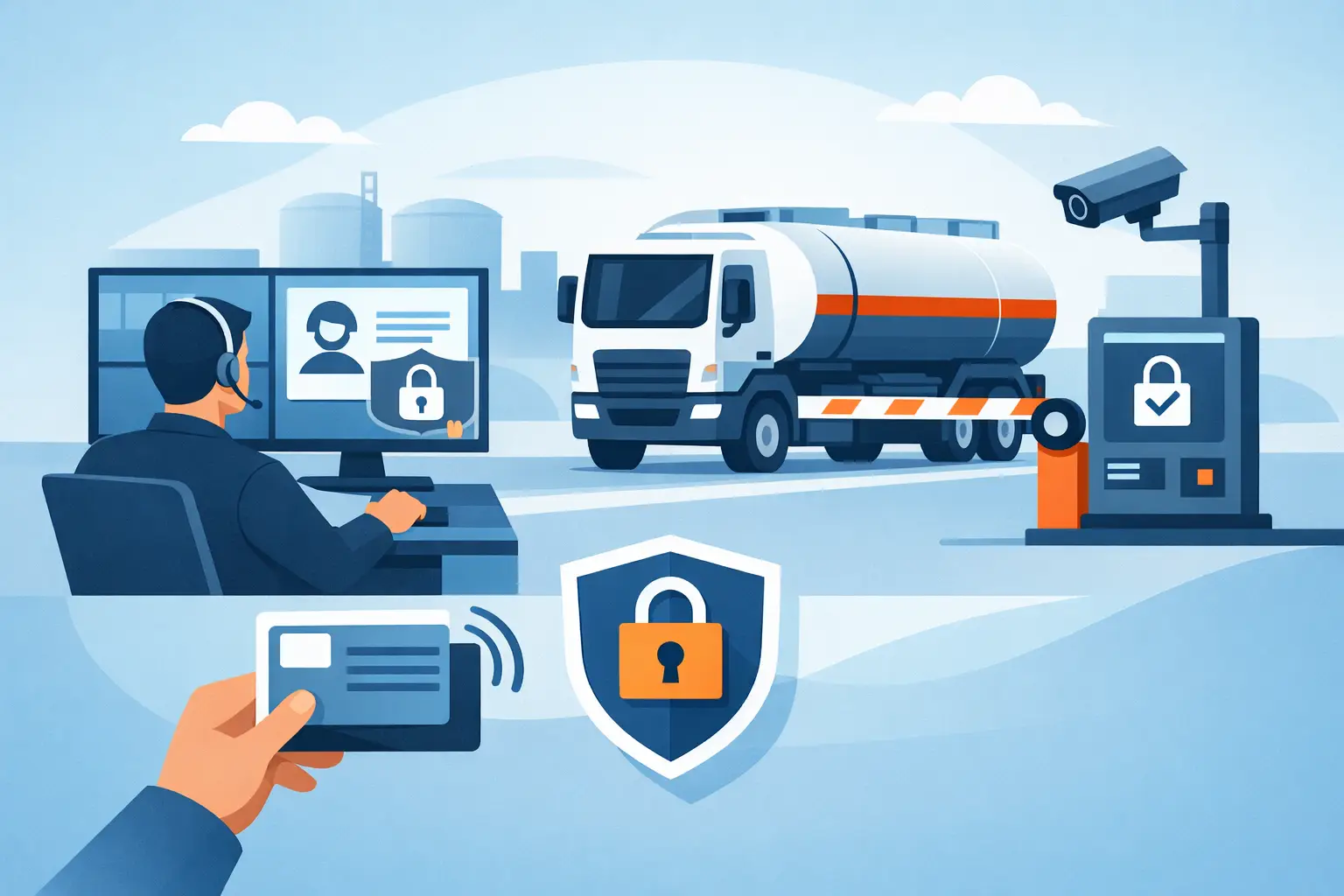
The most effective model places the decision to dispense at the point of use. The pump remains locked until an approved user requests access through a secure method, such as a smartphone app. Once the system verifies the user and the required transaction details, it permits dispensing and records the event automatically.
This matters because it removes the need to trust a shared physical key or rely on a driver to remember a paper process. Authorisation becomes an operational rule rather than an informal habit. A new operator can be given access immediately, while a departing employee or contractor can be deauthorised without recovering keys, changing locks or waiting for a site visit.
For a mobile unit, access rules should be specific enough to prevent misuse without slowing down legitimate work. An authorised driver may need permission to operate the pump during their shift, while a site technician may only need access to receive fuel into a named asset. The right level of restriction depends on how the unit is used, the size of the fleet and whether the lorry serves internal operations, customer sites or both.
Tie every dispense to a real person
User identity is the foundation of accountability. Each operator should have an individual account, not a shared crew login. Smartphone-based authorisation is particularly useful because the person requesting access carries their identity with them, rather than depending on a card or key that can be borrowed.
Individual credentials also make training and policy enforcement easier. If an employee has not completed the required fuelling or safety training, their access can be held back until they are approved. Where a contractor is only engaged for a short period, access can be created for that period and removed promptly when the work ends.
Identity alone is not enough, however. A sound process asks the operator to identify the receiving vehicle, equipment item or account before fuel flows. This creates a record that can be checked against vehicle usage, routes, jobs and expected consumption.
Capture the details that make records useful
A timestamp and fuel volume are essential, but they do not tell the whole story. A useful mobile fuelling transaction normally includes the operator, the mobile unit, the receiving asset, product type and quantity. Depending on the operation, it may also capture odometer or hour-meter readings, customer or cost-centre information, site details and job references.
The goal is not to make drivers complete unnecessary forms. It is to collect the minimum information needed to explain each litre and allocate cost accurately. If a field does not support a reporting, billing, maintenance or compliance decision, it may not belong in the workflow. Too many mandatory steps encourage workarounds; too few create blind spots.
Automated transaction records are preferable to after-the-fact data entry. When details sync to the cloud as the dispense happens, managers are not waiting for a paper sheet to return to the office or a spreadsheet to be updated at the end of the week.
Build permissions around roles, locations and risk
Access should not be all-or-nothing. A fleet manager may need visibility across every mobile and fixed dispensing location, while a driver should only be able to operate assigned equipment. A maintenance manager may need to review usage and exceptions but not dispense fuel. Separating these permissions reduces the risk of accidental changes and makes audits more straightforward.
Start with four practical controls:
- Role-based permissions determine whether someone can dispense, approve, edit records or view reports.
- Asset restrictions limit which fuel units, tanks or pumps a user can access.
- Time and shift rules prevent unauthorised out-of-hours dispensing where the operation requires it.
- Instant deauthorisation removes access as soon as employment, contractor status or operational need changes.
Not every fleet needs every restriction. A 24-hour airport operation will need a different configuration from a contractor with one mobile bowser serving local worksites. The key is to make exceptions deliberate and visible, rather than leaving permanent broad access in place because it is convenient.
Use live data to spot loss before it grows
Fuel losses rarely announce themselves as one obvious event. They often show up as small variances: a unit consistently dispensing more than expected, a vehicle receiving fuel outside its scheduled activity, or stock falling faster than issued volumes suggest. These are difficult to identify from paper logs, especially across multiple locations.
A cloud-connected system gives managers a current view of dispensing activity without chasing records. They can compare issued fuel against tank inventory, examine transactions by user or asset, and investigate exceptions while the details are still fresh. This is where access control becomes a financial control. The system does not only stop unauthorised use; it gives the business evidence to challenge errors, detect patterns and improve planning.
For organisations that bill fuel to clients or departments, real-time records also reduce disputes. A transaction tied to a named user, asset and timestamp is far easier to defend than a handwritten note with an unclear vehicle number.
Make physical security support the digital process
Digital authorisation should sit alongside basic physical safeguards. The fuel lorry should be secured when unattended, hoses and nozzles protected, and pump hardware selected for the working environment. Tank access, cabinets and emergency shut-offs need to be considered as part of the same security plan.
There is a trade-off here. Excessive physical barriers can slow emergency response or make routine work unnecessarily difficult. The aim is not to create friction for trained operators. It is to ensure that the pump cannot dispense simply because someone has reached the nozzle.
Managers should also define what happens when connectivity is weak. Mobile work regularly takes place in remote areas, so the access solution must be suited to real operating conditions and supported by clear procedures. Decide in advance who can approve exceptions, how they are documented and how the records are reconciled afterwards. An offline contingency should be controlled, not a return to unmanaged dispensing.
Reconcile stock and transactions as one process
Access control is only fully effective when transaction data is compared with physical inventory. Regular dip readings, meter totals and delivery records should be reviewed against the fuel issued from the mobile unit. The review frequency depends on volume and risk: a high-throughput unit or a unit serving multiple customer sites may justify daily checks, while lower-volume operations may use a different cadence.
When a variance appears, investigate the process before assigning blame. Check delivery quantities, meter calibration, asset selections, duplicate entries and possible leaks alongside user activity. The record should help the team find the cause, whether it is theft, an operational error or a maintenance issue.
Manage Every Drop helps fleets apply this control model with smartphone-authorised dispensing and cloud-based transaction logging across mobile fuel units and fixed sites. The advantage is straightforward: the pump stays locked until the right person is authorised, and every dispense becomes a real-time record rather than an end-of-shift guess.
A controlled fuel lorry does more than protect inventory. It gives drivers a clear process, gives managers evidence they can act on and gives finance a cleaner path to reconciliation. Start by identifying every person who can currently access the pump, then decide whether you can account for every litre they dispense. That answer will show you where control needs to begin.


Post a comment