
Onsite Fuel Software Review for Fleet Control
A missing 80 litres from a site tank rarely appears as a single obvious loss. It shows up as a variance, a late spreadsheet entry, an unexplained top-up or a driver who cannot remember which vehicle was filled. An onsite fuel software review should start there: not with a feature checklist, but with the level of control your operation needs over every dispense.
For fleet managers, finance teams and maintenance leaders, fuel software is not simply a reporting tool. It is the control point between stored fuel and an approved vehicle, person or asset. The right system creates an accountable transaction at the pump, reduces manual reconciliation and gives managers evidence they can act on before a small issue becomes a recurring cost.
What an onsite fuel software review should measure
The first question is whether the software controls dispensing or merely records it afterwards. There is a material difference. A system that relies on handwritten logs, shared keys or an end-of-week data upload may tell you what was entered. It cannot reliably prove who accessed the fuel, which vehicle received it or whether the volume was authorised at the time.
A stronger approach links authorisation to the actual dispense event. The user identifies themselves, the system validates their permission, the pump is released and the transaction is recorded in the cloud. That record should include the user, vehicle or equipment identifier, date and time, location, product and quantity. Where the operation requires it, odometer or hour-meter information should be captured too.
This is the foundation of accountability. It also changes the quality of your reporting. Instead of chasing incomplete paper tickets, managers can investigate exceptions with a clear transaction trail.
Security at the pump comes first
Every review should test how the system prevents unauthorised use in practice. Ask whether access can be granted and removed instantly, whether permissions can be tailored by person, site, fuel type or asset, and what happens when a phone has no signal. A convenient method that leaves the pump open to anyone on site is not a security control.
Smartphone-based authorisation can remove the expense and administration of physical tags or fobs, provided the solution has a dependable identity process and clear permission management. It is particularly useful for fleets with changing drivers, contractors, seasonal staff or multiple depots. When a user leaves or a role changes, access should be removed centrally rather than waiting for a key or card to be returned.
Security also needs to suit the environment. Fuel islands, yards and mobile fuel lorries are hard on equipment. The hardware must be rugged enough for weather, dust, vibration and daily use, while the software must remain simple enough that drivers do not create workarounds.
Records must be useful, not merely available
Many products promise reports. The practical test is whether a controller can reconcile a delivery, tank inventory and issued fuel without building a separate spreadsheet every month. Look for real-time transaction visibility, exports that fit your finance workflow and reports that identify exceptions rather than burying them.
Useful exceptions include fuel issued outside expected hours, transactions without a vehicle identifier, unusual quantities, repeated fills and dispensing at a location where the user should not have access. The software will not decide every question for your team, but it should make the questions visible quickly.
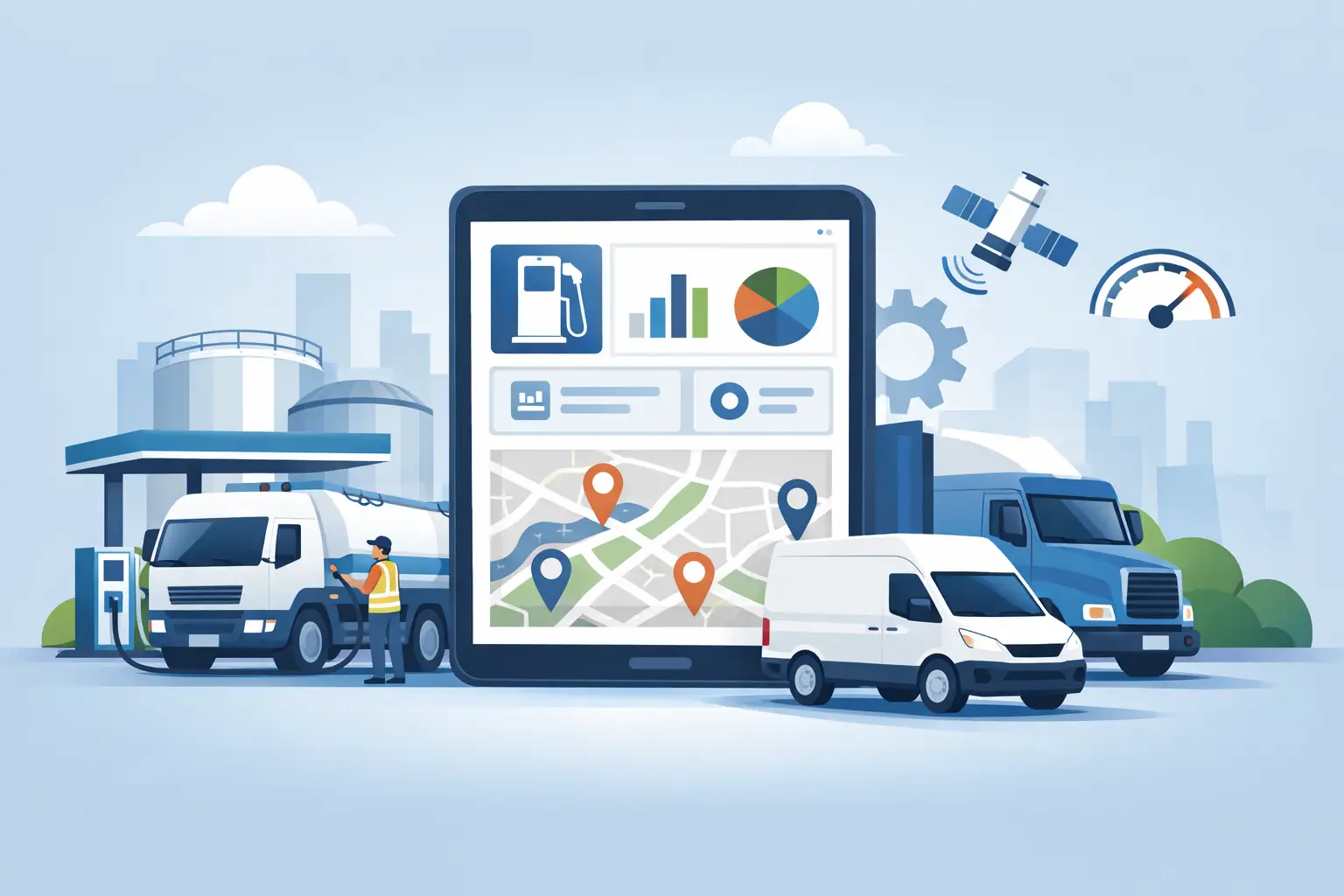
For multi-site operators, central visibility is essential. A fleet manager should not need to telephone each depot to establish yesterday’s fuel activity. One dashboard can standardise reporting across fixed tanks, mobile fuel units and different regions, while still allowing local managers to see the information relevant to their site.
Comparing onsite fuel software with legacy systems
Traditional pedestal-based fuel management systems can be effective, especially where a site has complex integrations or a long-established control process. They may, however, require specialised hardware, higher installation effort and more maintenance. Their physical footprint can also make expansion costly when adding pumps or sites.
Cloud-connected systems take a different approach. They place the intelligence around authorisation and transaction capture, then make the data available centrally. This can reduce hardware complexity and allow software updates to be managed without visiting every location. For operators replacing manual processes or ageing terminals, that difference often matters more than an impressive list of secondary features.
The trade-off is that cloud systems should be assessed for connectivity behaviour, user adoption and implementation support. Ask how transactions are handled during a communications interruption, how quickly data synchronises afterwards and who supports the site if a pump connection needs attention. The cheapest quote is not necessarily the lowest cost of ownership if it creates downtime, poor records or a support gap.
When comparing providers, focus on these operational questions:
- Can the system stop an unauthorised person from dispensing before fuel leaves the tank?
- Can managers see and export a complete transaction record without waiting for manual uploads?
- Can user permissions be changed immediately across every relevant site?
- Does it work for both stationary tanks and mobile dispensing operations?
- What installation, training, aftercare and hardware maintenance are included?
A provider should answer these questions clearly, with a demonstration based on your actual workflow. If your fleet dispenses diesel to lorries at several yards, do not accept a demonstration built only around a single, tidy pump installation.
Deployment determines whether the system delivers value
Fuel controls fail when they add too many steps at the point of work. Drivers need a fast, consistent process. Managers need enough mandatory information to maintain accountability, without forcing users to type unnecessary details in poor weather or at the end of a long shift.
Before implementation, map the journey from fuel delivery to monthly reconciliation. Identify who receives deliveries, who is authorised to dispense, which assets require IDs, who investigates variances and who needs reports. This creates a configuration that reflects your operation rather than a generic template.
It is also worth deciding how to handle exceptions before launch. A driver may arrive with a dead phone battery, a vehicle may be temporarily off the road, or a contractor may need urgent access. A good system allows controlled exception processes without turning every exception into an untracked dispense. The objective is not to make work difficult. It is to ensure every litre has an accountable path.
Training should be brief, practical and role-specific. Drivers need to know how to authorise a dispense and correct an entry. Site managers need to manage local issues. Administrators need to add and remove permissions, review alerts and run reports. The best suppliers remain available after installation, because configuration and reporting needs change as fleets grow.
Cost should be measured against loss and labour
Purchase price matters, but it is only one part of the decision. Include installation, hardware, subscriptions, maintenance, staff time spent on reconciliation and the cost of unresolved stock variances. A low-cost system that still depends on paper logs can leave the expensive part of the process untouched.
Equally, avoid paying for enterprise complexity your fleet will never use. A smaller operator with one tank may need secure authorisation, clean transaction records and simple reporting. A larger business may need multi-location controls, role-based permissions, vehicle data capture and integrations. The right scope depends on the risk, volume and administrative burden at each operation.
Manage Every Drop pairs smartphone-authorised pump control with cloud transaction records so fleets can secure fixed and mobile dispensing without relying on cumbersome legacy pedestal infrastructure. For buyers, the value is straightforward: fewer uncontrolled dispenses, faster reconciliation and a clearer audit trail when questions arise.
The strongest buying decision is usually made after a short pilot or workflow demonstration. Test the system against a real shift, a real driver and a real reconciliation task. If it makes authorised dispensing easier and unauthorised dispensing harder, it is doing the job that matters.
Start with the pump where visibility is weakest. The answers it produces will show you exactly where better control can protect margin, improve confidence and give your team a record they can trust.


Post a comment