



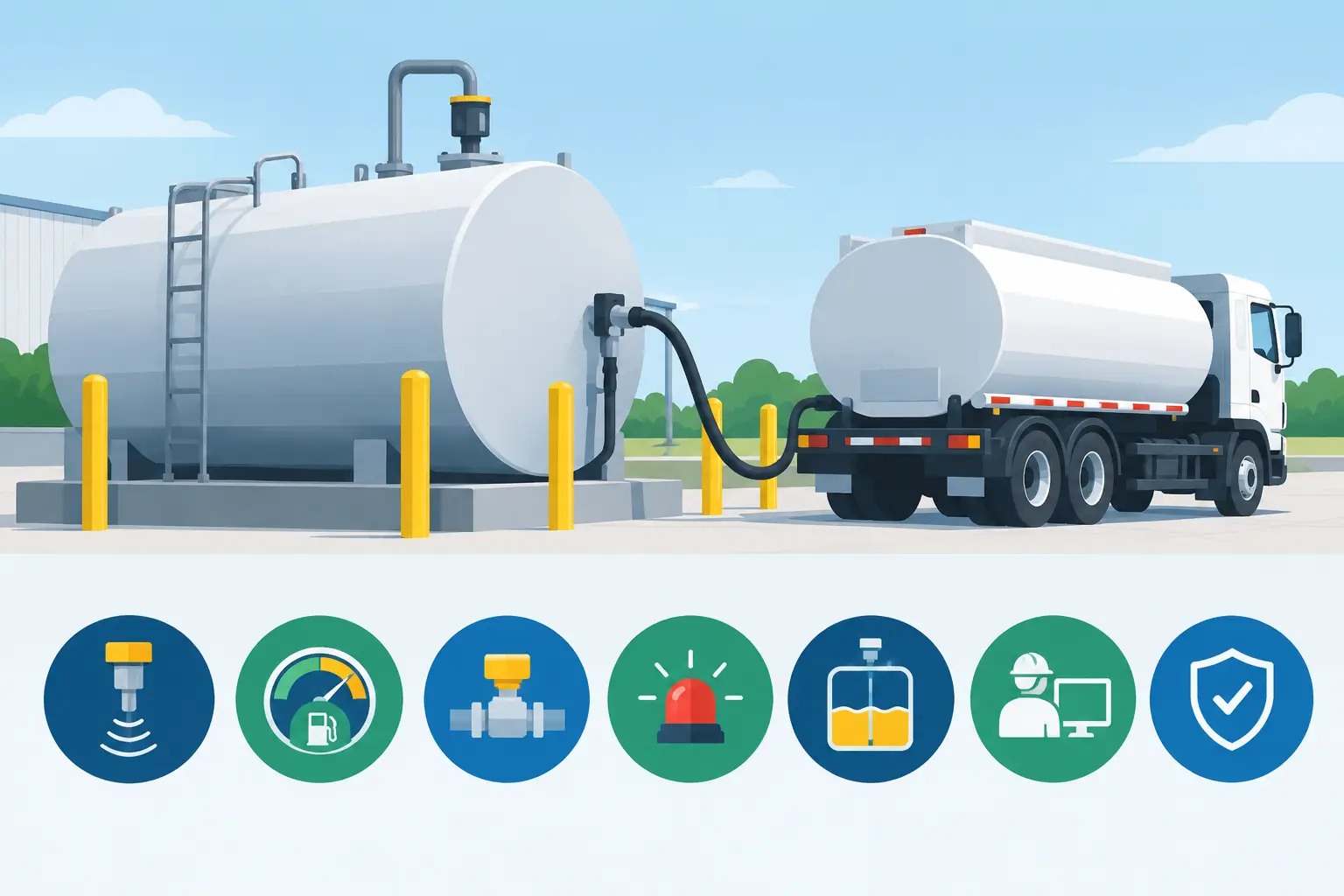
7 Diesel Tank Overfill Prevention Methods
A diesel tank does not need to spill for an overfill event to cost your operation money. A missed high-level alarm, an inaccurate delivery estimate or an unattended transfer can leave you with contaminated ground, lost product, disrupted work and difficult reporting. Effective diesel tank overfill prevention methods protect more than the tank – they protect the accountability around every litre received, stored and dispensed.
For fleet yards, depots, airports and mobile fuelling operations, prevention should not depend on one person remembering to stop a pump at the right moment. The safest approach combines correctly specified equipment, clear procedures and real-time visibility of inventory and transactions.
Why diesel tank overfills happen
Most overfills begin with a gap in information or control. The delivery quantity may be larger than the available tank capacity. A gauge may be inaccurate, damaged or not checked before a delivery. In other cases, staff assume a tank has more free capacity than it does because recent dispensing has not been recorded promptly.
Human factors matter too. A driver may be managing more than one compartment, a receiving employee may leave the fill point unattended, or communication may break down during a busy shift. Mobile fuel units add further variables: changing locations, uneven ground, varying customer-site procedures and the need to reconcile stock after every route.
The result is not simply wasted diesel. A spill can create slip and fire risks, require environmental response, damage customer confidence and complicate compliance documentation. It can also hide a wider inventory-control issue. If a business cannot reliably see what entered the tank, what was dispensed and what remains, it cannot confidently identify losses.
7 diesel tank overfill prevention methods
1. Confirm available capacity before every delivery
The receiving operator should know the tank’s usable capacity, current measured volume and expected delivery amount before fuel begins to flow. Do not rely on a nominal tank size alone. Tanks need safe headspace, and usable capacity can be affected by tank geometry, gauge tolerance, temperature and product already in transfer lines.
Create a simple pre-delivery verification process: check the latest tank reading, compare it with recorded dispensing since the last confirmed reading, and confirm that the proposed delivery will fit with a sensible margin. Where several tanks or compartments are involved, document which product is going into which tank before hoses are connected.
2. Use dependable level measurement and high-level alarms
A calibrated tank gauge gives operators the information needed to make sound receiving decisions. For higher-risk sites, continuous level monitoring with a visible local display and remote notification provides a stronger safeguard than manual dipping alone.
High-level and high-high-level alarms add a vital independent layer. The first alarm tells the operator that the planned fill limit is approaching. The high-high alarm should trigger an immediate response, such as stopping the transfer or closing an automated valve where the installation has been properly designed for it.
Alarms are only useful when they are tested. Include alarm checks in scheduled maintenance, investigate nuisance alarms rather than silencing them, and make sure responsible staff know exactly what each alarm requires them to do.
3. Fit correctly designed overfill protection equipment
Mechanical overfill prevention valves, fill-limit devices and automatic shut-off systems can stop or restrict flow when the tank reaches a preset level. The right equipment depends on the tank type, delivery arrangement, product, flow rate and applicable site requirements.
These devices are not a substitute for supervision. A valve can be incorrectly specified, poorly maintained or affected by operating conditions. Treat it as a protective layer, alongside verified capacity, level monitoring and a trained person at the receiving point.
Any modification should be assessed by a competent fuel-storage professional. A poorly matched component can cause pressure issues, slow deliveries or create a false sense of security. The objective is a system that works reliably in your actual operating conditions, not merely one that looks compliant on paper.
4. Keep transfers attended from start to finish
Someone with authority to stop the delivery should remain present throughout the transfer. That person should have a clear view of the tank level indication or alarm, access to emergency shut-off controls and direct communication with the delivery driver.
Before starting, inspect hoses, couplings, vents and the fill connection. Confirm that the correct tank is selected and that no valve configuration can send diesel to an unintended tank. During the delivery, avoid unrelated tasks such as answering calls, moving vehicles or completing paperwork away from the fill point.
This may appear basic, but it is one of the most reliable controls available. Overfills often escalate because the first warning is not seen or acted on quickly enough.
5. Standardise the delivery procedure across every site
A written receiving procedure turns good practice into a repeatable control. It should state who can authorise deliveries, how capacity is calculated, what must be checked before transfer, who monitors the fill, and what happens if an alarm activates or a discrepancy is found.
For multi-site fleets, standardisation is especially valuable. It reduces dependence on local habits and makes training, auditing and incident reviews far more straightforward. The procedure should cover contractors and temporary staff, not only permanent employees.
Keep the process practical. If it is too complicated for a busy depot, people will work around it. A concise checklist at the fill point, backed by training and management follow-through, is often more effective than a lengthy policy stored in an office.
6. Reconcile delivered, stored and dispensed fuel promptly
Overfill prevention improves when inventory records reflect reality. Compare delivery tickets with tank readings, then reconcile those figures against authorised dispensing transactions. A discrepancy may indicate an inaccurate gauge, an unrecorded issue, a delivery error, a leak or unauthorised fuel use.
This is where cloud-based fuel management delivers a practical advantage. When each dispense is tied to an authorised user, vehicle or asset and recorded immediately, managers have a much clearer picture of stock movement. They are not waiting for paper logs to be collected or trying to reconstruct activity at month end.
Manage Every Drop’s FluidSecure™ approach supports this level of control by locking access to pumps until a user is authorised, then creating an auditable transaction record for each dispense. That data does not replace tank monitoring, but it gives operations teams stronger inventory visibility between deliveries and faster answers when readings do not align.
7. Prepare for the moment prevention fails
Even well-run sites need an emergency response plan. Keep spill kits accessible, identify emergency shut-offs clearly and train staff to stop the source, protect drains where safe to do so, secure the area and report the incident through the correct channels.
The plan should define escalation responsibilities, including environmental reporting requirements relevant to your site and jurisdiction. Review every incident and near miss. A near miss is useful evidence: perhaps the alarm was hard to hear, the fill point was poorly lit, or the delivery quantity was not confirmed clearly.
The role of accountability in preventing overfills
Equipment stops fuel at a physical limit. Accountability helps prevent the conditions that bring you to that limit in the first place. When receiving, dispensing and inventory information sits in separate notebooks, spreadsheets and memory, a fleet manager is forced to make decisions with incomplete information.
A controlled process creates a chain of evidence. You can see when fuel arrived, who accepted it, what the tank level was, what was dispensed afterwards and where an unexpected variance first appeared. This makes it easier to address small problems before they become a spill, a costly stock adjustment or an avoidable service interruption.
The right balance depends on the operation. A single small tank may need a disciplined manual check, a reliable gauge and a clear delivery routine. A large depot with multiple tanks, shifts and mobile fuel assets will usually benefit from automated level data, high-level protection and cloud-based dispensing records. In both cases, the principle is the same: do not leave tank capacity and fuel movement open to assumption.
Start with the next delivery. Ask whether the person receiving it can prove available capacity, see a warning early enough to act and reconcile the fuel afterwards. If the answer is no, that is the most useful place to strengthen control.

Post a comment