



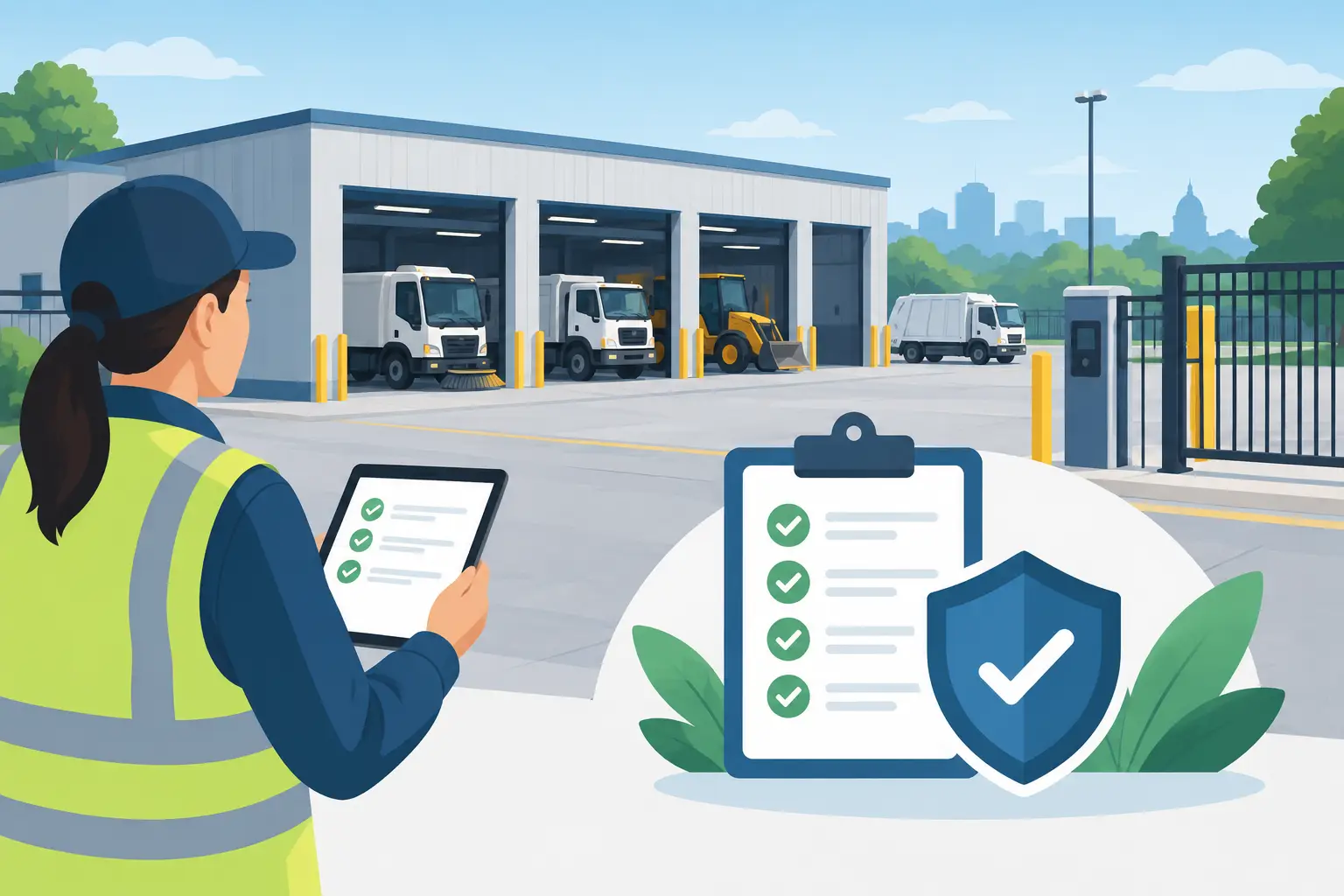
Municipal Depot Access Results That Stand Up to Audit
A missing 80 litres from a municipal depot is rarely just an 80-litre problem. It can signal an open pump, an outdated staff list, a failed paper process, or a transaction that no one can confidently trace. Strong municipal depot access results turn that uncertainty into evidence: who accessed the pump, which vehicle or asset received fuel, how much was dispensed, and when it happened.
For councils, highways teams, parks departments, waste fleets and public works operations, depot fuel is a controlled public resource. The standard should not be a monthly estimate and a stack of handwritten sheets. It should be immediate accountability at every dispense.
What municipal depot access results should prove
Access control is sometimes treated as a security feature separate from fuel reporting. In practice, the two are inseparable. If a depot cannot reliably establish who was authorised to dispense, its fuel records cannot provide a dependable basis for reconciliation, internal review or budget planning.
Useful results answer the operational questions that matter without forcing staff to reconstruct events days later. They show the authorised person, the pump or tank used, the date and time, the volume, and the vehicle, equipment or job reference associated with the transaction. That record should be available centrally, not trapped at one depot office or dependent on a supervisor finding a clipboard.
The difference is especially clear when an exception occurs. A high-volume fill outside normal working hours may be entirely legitimate during winter response or emergency call-outs. The issue is not that it happened. The issue is whether the organisation can verify the reason quickly, identify the authorised operator, and confirm the fuel went to the right asset.
Why open access creates costly blind spots
Many municipal depots still rely on keys, PINs shared across shifts, physical cards or a pump that is simply available to anyone on site. These approaches can appear convenient, but they make individual accountability weak. When several people can use the same credential, the record identifies a device or a code, not a person.
Paper logs create a different problem. They depend on busy drivers and operators completing every field accurately in poor weather, at shift changes or during urgent work. Even conscientious teams can leave gaps. A vehicle number may be written incorrectly, a meter reading may be missed, or a sheet may reach the office too late for meaningful review.
Those gaps affect more than fuel loss. They can distort cost allocation between departments, hide unusual consumption, complicate inventory checks and make it harder to spot a vehicle developing a mechanical issue. When an auditor, finance team or senior manager asks why stock and transaction totals do not align, manual processes offer too many explanations and too little proof.
Secure access creates better results at the pump
The most effective approach ties permission to an identifiable user and records the transaction as the dispense happens. An operator requests access through an approved method, the system checks whether that person is currently authorised, and the pump is enabled only for that transaction. Once dispensing is complete, the event is recorded in the cloud for review.
This model improves control without making depot work harder. Permission can be granted to a new starter, changed when job duties move, or removed immediately when employment ends. That is a significant improvement over recovering keys, changing locks or hoping a shared code is no longer in circulation.
For a municipal operation with more than one yard, the value grows further. A fleet manager can apply consistent rules across locations while still allowing practical differences between a central depot, a satellite yard and a mobile fuelling unit. A gritter operator may need access before dawn in winter. A seasonal contractor may need restricted access for a defined period. Controls should reflect those realities rather than forcing every site into the same rigid routine.
The record must be usable, not merely collected
A transaction log has value only when it supports action. Managers need to filter activity by site, user, vehicle, tank or date range, then compare dispenses with stock movement and fleet usage. Finance teams need records that can be reconciled without rekeying paper forms. Supervisors need a clear exception trail when a fill does not match the expected pattern.
Real-time visibility also changes the conversation. Instead of asking at month end whether a variance can be explained, a manager can review an unusual transaction while the details are still fresh. That protects honest operators as much as it protects the budget. A clear, time-stamped record removes guesswork when legitimate work falls outside the usual pattern.
Measuring municipal depot access results that matter
The right measures depend on the size of the fleet, the number of locations and the type of work performed. A refuse fleet with fixed routes will have different fuel patterns from a highways team responding to storms. Still, several indicators are useful across most municipal depots:
- the percentage of dispenses matched to an authorised user and a named asset;
- the time required to reconcile tank stock against recorded transactions;
- the number and value of unexplained inventory variances;
- the frequency of after-hours or exception dispenses reviewed by a supervisor; and
- the time needed to add, amend or remove a user’s access.
These figures should not be used in isolation. A rise in fuel consumption may reflect extended winter operations, a new service area or older equipment working harder. The point is to create a dependable baseline, then investigate exceptions using records rather than assumptions.
It is also wise to distinguish between fuel accountability and fuel efficiency. Secure access tells an organisation whether a dispense was authorised and properly attributed. It does not, by itself, prove a vehicle is using fuel efficiently. Pair access data with mileage, engine hours, route information and maintenance records to understand the full picture.
Implementation choices determine adoption
A secure system succeeds when it works at the pace of the depot. If authorisation takes too long, requires specialist training or fails in harsh conditions, staff will look for workarounds. Hardware needs to be rugged, the process needs to be clear, and support needs to be available when operations cannot wait.
Before choosing a system, map how fuel actually moves. Identify stationary tanks, mobile fuel bowsers, high-use periods, off-hours requirements, temporary staff and contractors. Decide what information operators must provide at the point of dispense. Asking for every possible detail can reduce data quality if it slows the queue; asking for too little limits later analysis. In many cases, user identity, asset identity and volume provide the essential foundation.
Legacy pedestal-based systems can deliver control, but their installation, maintenance and expansion costs may not suit every council or department. Smartphone-authorised systems can reduce hardware complexity while still creating a secure, auditable record. The best choice depends on site connectivity, environmental conditions, procurement requirements and how many pumps or locations need to be managed.
Manage Every Drop Inc helps fleet operators apply smartphone authorisation and cloud-based transaction records to both fixed and mobile dispensing environments, with a focus on practical deployment and ongoing accountability.
Put access control at the centre of depot governance
Depot access should be reviewed as part of operational governance, not left solely to facilities or fleet maintenance. Finance needs reliable transaction data. Operations needs uninterrupted access for authorised teams. Supervisors need clear exception reporting. Procurement needs a system that is affordable to maintain as requirements change.
Set clear rules for who can authorise users, how often permissions are reviewed, and who investigates irregular activity. Then communicate the purpose to operators plainly: this is not about adding friction or presuming misuse. It is about protecting public funds, simplifying administration and ensuring every authorised team member can do their work without being questioned later because the record is incomplete.
The strongest municipal depot access results are not measured by how many people are denied at the pump. They are measured by how confidently a council can account for every litre, support its staff, and act quickly when the numbers point to a problem.


Post a comment