
Mobile Fuel Truck Dispensing Controls Explained
A mobile fuel lorry is only efficient when every litre is controlled. Without clear authorisation, transaction logging and real-time visibility, a vehicle designed to keep operations moving can just as easily become a blind spot for fuel loss, manual errors and disputed usage. That is why mobile fuel lorry dispensing controls matter so much for fleet operators, airports, contractors and any organisation managing fuel away from a fixed site.
For many operators, the problem is not dispensing fuel. It is proving who took it, when they took it, how much was issued and whether that transaction matched the job, asset or shift it was meant to support. Paper logs, keys, shared PINs and end-of-day spreadsheets leave too much room for shrinkage and too little accountability. Once fuel is moving across multiple locations and vehicles, those gaps become expensive.
What mobile fuel lorry dispensing controls actually do
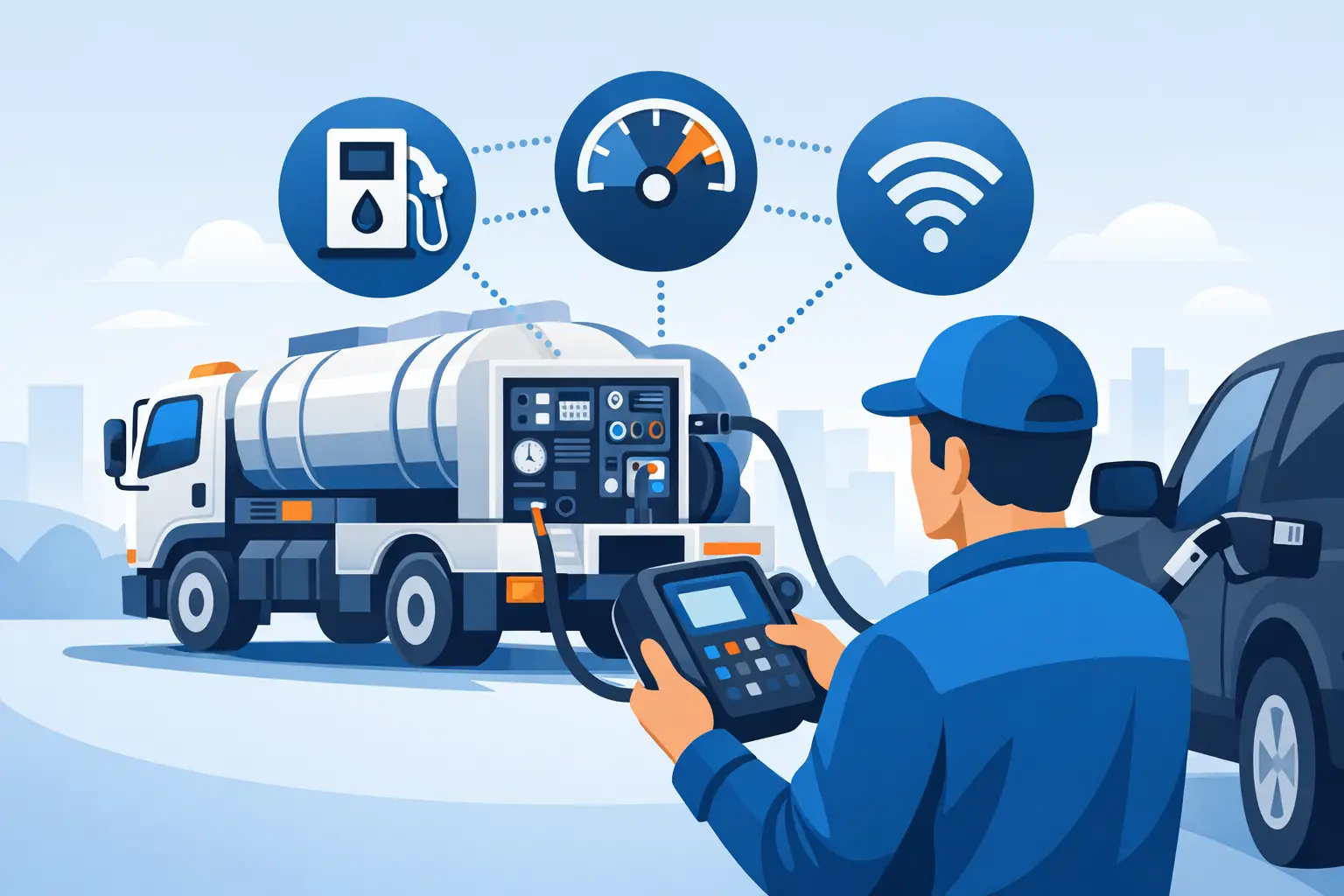
At a practical level, mobile fuel lorry dispensing controls govern who can dispense fuel from a mobile unit and create a record of the event. The best systems do more than switch a pump on and off. They tie access to an identified user, connect the dispense event to a vehicle or asset, capture volume and timing, and push that data into a central platform for reporting and reconciliation.
That sounds straightforward, but the difference between basic and effective control is significant. A simple lock can stop casual misuse. A proper control system creates an auditable chain of custody around every dispense. For operations teams, that means tighter discipline in the field. For finance teams, it means cleaner reconciliation. For management, it means fewer assumptions and faster answers.
Mobile applications have changed the category. Instead of relying on a dedicated pedestal, a separate reader or a fragile on-vehicle keypad, modern systems can authorise fuelling through a smartphone and send transactions directly to the cloud. That reduces hardware complexity on the vehicle while improving visibility across the fleet.
Why older mobile fuel lorry dispensing controls fall short
Traditional mobile fuel lorry dispensing controls often grew out of fixed-site thinking. They were built around local hardware, isolated user databases and manual data collection. That approach can work on paper, but it becomes harder to manage when fleets scale, staff change regularly or operations run across dispersed sites.
The first issue is permission control. If a driver leaves, changes role or loses access privileges, delays in updating credentials create risk. The second is data lag. If transaction records are only available when someone retrieves them manually, managers are always looking backwards. The third is maintenance. More hardware on the vehicle usually means more failure points, more service calls and more downtime.
There is also a hidden cost in inconsistency. If fixed tanks use one control process and mobile units use another, reporting becomes fragmented. The result is extra administration, disputed numbers and less confidence in inventory data. In fuel management, inconsistency is expensive because it weakens both control and decision-making.
What good control looks like in the field
A strong dispensing control system should make unauthorised fuelling difficult and authorised fuelling simple. That balance matters. If the process is too loose, fuel walks. If it is too awkward, staff find workarounds.
In the field, good control usually starts with identity-based access. Each dispense should be linked to a specific authorised person rather than a shared code or vehicle key. From there, the system should capture the date, time, quantity and dispensing unit, and ideally associate the event with a vehicle, registration, asset or cost centre.
Cloud-connected reporting is equally important. Managers should not have to wait for someone to come back to the yard before seeing what happened. Real-time or near real-time transaction visibility helps spot unusual activity quickly, whether that is fuelling outside normal hours, repeated small dispenses or unexpected volume trends.
Durability matters too. Mobile fuel environments are not gentle. Equipment faces vibration, weather, dust, impact and heavy daily use. Dispensing controls need to be rugged enough for that reality, not just functional in ideal conditions.
The operational value beyond theft prevention
Most buyers first look at mobile fuel lorry dispensing controls as a security measure, and that is fair. Preventing unauthorised use is a direct, measurable win. But the operational value goes further.
Better control shortens reconciliation time because transactions are recorded automatically instead of reconstructed later. It improves stock visibility because dispensed volumes are captured consistently. It supports compliance because fuelling records are easier to retrieve and review. It also helps standardise process across sites, crews and shifts.
That matters in organisations where mobile units support critical operations. If a fuel lorry services plant equipment, generators, airside assets or remote fleet vehicles, delays and uncertainty around fuelling records create knock-on problems for maintenance planning, budgeting and customer billing. A controlled dispense event is not just a fuel record. It is an operations record.
There is also a people management benefit. When every issue is tied to an authorised user, expectations become clearer. Staff know the process, supervisors have cleaner data and disputes are easier to resolve. Accountability improves because the system does not depend on memory.
Choosing mobile fuel lorry dispensing controls for your fleet
Not every operation needs the same level of control, so selection should start with risk and workflow. A small fleet with one mobile unit may prioritise ease of use and cost. A multi-site operation with high fuel volume may need centralised permissions, tighter reporting and stronger audit capability.
Look first at how authorisation works. If access cannot be granted or removed quickly, the system creates admin friction and security exposure. Instant permission changes are especially valuable for businesses with contractors, seasonal staff or multiple operating locations.
Then look at data flow. Ask how transactions are captured, where they are stored and how quickly they can be reviewed. If your team still has to pull logs manually or combine records from separate systems, you are not really simplifying control.
Hardware footprint is another practical factor. Mobile units benefit from less complexity, not more. Systems with fewer dedicated components on the vehicle are often easier to install, easier to maintain and cheaper to support over time. Lower upfront cost matters, but lower maintenance burden is often where the long-term savings show up.
Usability should not be overlooked. If drivers and operators need extensive training just to dispense fuel, adoption will suffer. A clear, familiar interface – especially one based on a smartphone – can make compliance far more realistic in day-to-day use.
Why a unified approach works better
Many organisations still manage fixed tanks and mobile units with different processes. That creates unnecessary gaps. A unified control platform gives fleets one way to authorise users, one transaction history to review and one reporting environment to reconcile against inventory and usage.
That is where modern solutions stand apart. Instead of layering separate technologies across each fuelling scenario, the smarter approach is to use one cloud-connected system that secures both fixed and mobile dispensing. It reduces admin burden, improves data consistency and gives decision-makers a clearer picture of fuel movement across the whole operation.
For businesses focused on reducing loss and proving accountability, that consistency is valuable. It turns fuel control from a patchwork of local procedures into a managed business process. Manage Every Drop has built its offering around that principle, pairing secure smartphone-based authorisation with cloud transaction records to help operators control and document every dispense event without the cost and maintenance profile of older pedestal-style systems.
The trade-off to keep in mind
There is no single control setup that suits every fleet perfectly. A highly configurable system may offer deeper reporting and tighter permissions, but it still needs to fit the pace of field operations. Likewise, a very simple setup may be quick to deploy, but if it cannot provide auditable records, the hidden cost appears later in loss, investigation time and weak reconciliation.
The right decision usually comes down to this question: does the system give you certainty at the point of dispense, not just a record after the fact? If it does, you are improving security, accountability and operational control at the same time.
For fleets running mobile fuelling, that level of certainty is no longer a nice-to-have. It is the standard that protects margin, supports compliance and keeps every litre working where it should. The strongest mobile fuel lorry dispensing controls do exactly that – quietly, consistently and every day.


Post a comment