

Integrating Tank Gauges with Fuel Logs Properly
A fuel discrepancy is rarely just a number on a spreadsheet. It can mean an unrecorded dispense, a delivery shortfall, a leaking tank, a faulty gauge or fuel being used by an unauthorised vehicle. Integrating tank gauges with fuel logs gives fleet operators the evidence needed to identify which of those explanations is most likely – before a small variance becomes an expensive recurring loss.
For organisations operating on-site tanks, depots, airports or mobile fuel units, the objective is straightforward: every litre entering storage and every litre leaving through a pump should have a record. The challenge is making those records agree without relying on manual dip readings, paper tickets and end-of-month guesswork.
Why tank readings and transaction logs must work together
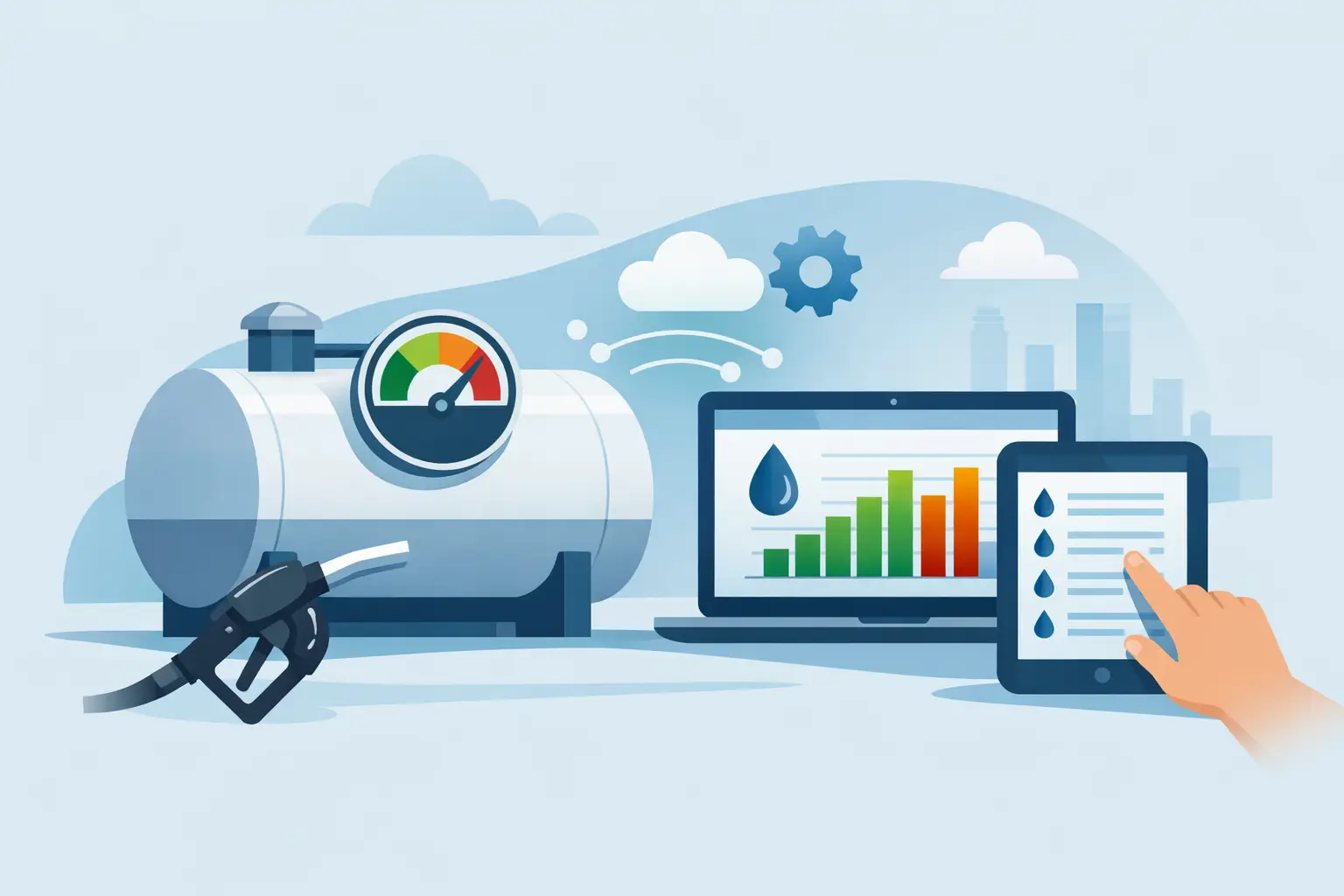
A tank gauge answers one critical inventory question: how much product is believed to be in the tank right now? A fuel log answers another: who dispensed fuel, to which vehicle or asset, when, where and in what quantity? Neither view is complete on its own.
A gauge can show a falling stock level, but it cannot explain whether the reduction relates to authorised fuelling, evaporation, a leak or an inaccurate reading. A dispensing log can show that 2,000 litres were issued, but it cannot confirm that the tank balance changed as expected after deliveries, temperature effects and normal operational tolerances are considered.
When the two records are reviewed together, fuel inventory becomes accountable. Operations teams can compare expected book stock against measured tank stock, investigate exceptions promptly and build a defensible audit trail for management, finance and compliance purposes.
Integrating tank gauges with fuel logs: what good looks like
The most useful integration is not simply a dashboard showing two sets of numbers. It is a process that aligns the timing, units and site information behind those numbers.
At a minimum, each site should have a reliable starting inventory, a record of every delivery, authorised dispensing transactions and scheduled tank-level readings. The system or reconciliation process then calculates expected stock. That figure is compared with the actual gauge reading to produce a variance.
For example, a depot begins the day with 12,000 litres in a diesel tank. A supplier delivers 8,000 litres, and the fuel management system records 5,400 litres dispensed through the day. Expected closing stock is 14,600 litres. If the gauge reports 14,050 litres, the 550-litre difference requires attention. It may be a timing issue, a delivery measurement issue, gauge calibration, an unrecorded transfer or loss. The point is not to assume the cause. The point is to see the variance early enough to investigate it properly.
Start with clean transaction data
Integration is only as dependable as the records behind it. If drivers can dispense without identification, if vehicle details are optional or if fuel issues are entered after the fact, reconciliation will remain uncertain.
Secure pump access changes that. Each dispense should be tied to an authorised person, vehicle, asset or cost centre, with a precise timestamp, fuel type and volume. Cloud-connected authorisation also allows permissions to be changed immediately when staff leave, duties change or a vehicle is taken out of service.
This is where a smartphone-authorised platform such as FluidSecure can strengthen the process. It creates an auditable transaction at the pump rather than asking staff to reconstruct activity from handwritten logs later. That provides a far more dependable record for matching against tank movements.
Match the correct tank, product and location
Multi-site fleets often lose visibility because records are grouped too broadly. Diesel at one depot is not interchangeable with diesel in a mobile fuel unit, and petrol should never be reconciled against a diesel tank simply because both are shown under one site heading.
Assign a clear identifier to every tank, pump and dispensing point. Each fuel transaction must be mapped to the source tank where possible. This matters particularly for sites with multiple grades, split tanks, bulk oil storage or separate fuelling lanes for different fleets.
The same discipline applies to deliveries. Record the receiving tank, delivered quantity, delivery time and supplier reference. If a delivery is booked against the wrong tank or entered a day late, the resulting variance can send teams looking for a problem that does not exist.
Choose the right reading frequency
More readings do not automatically mean better control. Reading frequency should match the volume, risk and operational role of the tank.
A high-throughput fleet depot may need continuous or hourly automated readings to maintain close control during active dispensing periods. A lower-volume reserve tank may only require a daily reading and a physical verification at set intervals. Mobile fuel units may need readings before departure, after return and after any bulk refill.
The trade-off is practical. Frequent telemetry provides faster exception detection and stronger inventory visibility, but it also requires appropriate hardware, communications and maintenance. A daily reading can be sufficient for a stable, low-volume site, provided every dispense is securely recorded and variances are reviewed consistently.
Build a reconciliation routine that leads to action
A reconciliation report is useful only when someone owns it. Assign responsibility for reviewing variances, checking unusual transactions and confirming that deliveries were entered correctly. For larger operations, this might sit with a fuel administrator or finance controller, with site managers responsible for local follow-up.
Set sensible variance thresholds based on tank size, fuel type, throughput and gauge accuracy. A 50-litre difference may be material for a small tank but irrelevant for a large bulk installation. Thresholds should account for known measurement tolerances, not create a flood of false alerts that staff learn to ignore.
When a threshold is exceeded, follow a consistent sequence: confirm that all deliveries and transfers have been recorded, review dispensing transactions, check for duplicate or missing entries, inspect the tank and pump equipment, then assess whether a physical dip or gauge calibration is needed. Preserve the outcome of the investigation. Repeated small discrepancies can reveal a pattern long before one major shortage appears.
Do not overlook gauge accuracy
Tank gauges are valuable instruments, but they are not infallible. Their readings can be affected by calibration, tank geometry, sensor condition, product temperature, water ingress and communications faults. An integration that treats every reading as absolute truth can create as many problems as it solves.
Validate gauge data against physical measurements at an appropriate interval. Review the tank chart and ensure it reflects the actual tank dimensions and orientation. If a tank has settled, been repaired or had its configuration changed, its historical calibration may no longer be accurate.
Also account for timing. A gauge reading taken during a delivery, immediately after a large dispense or while fuel is settling may not be directly comparable with a transaction total captured at a different moment. Standardising cut-off times makes daily comparisons more meaningful.
Use exceptions to improve operations, not just catch losses
The immediate benefit of integrated records is loss reduction. Unauthorised fuelling, missing transactions and unexplained stock movements become harder to hide. But the operational value goes further.
Accurate fuel logs can expose assets with unusually high consumption, vehicles filled outside expected shifts, repeated top-ups that suggest a maintenance issue, and sites where delivery timing creates avoidable stock-out risk. Finance teams gain cleaner cost allocation. Operations managers gain a clearer picture of fuel availability. Maintenance teams get evidence that may support investigation into fuel use or equipment faults.
This is especially valuable across several locations. Centralised reporting allows leaders to apply the same controls at each site without installing complicated, maintenance-heavy pedestal systems everywhere. A consistent authorisation and logging process makes comparisons fairer and site performance easier to manage.
The practical standard for accountable fuel inventory
The strongest fuel control programmes do not rely on a single device, report or inspection. They connect secure dispensing, accurate tank measurement, disciplined delivery recording and regular reconciliation into one routine.
That routine should be simple enough for site staff to follow every day and detailed enough for management to trust when a discrepancy appears. When tank levels and fuel logs tell the same story, fleet operators gain more than a cleaner report – they gain the confidence to act on real data, protect stock and account for every drop.


Post a comment