



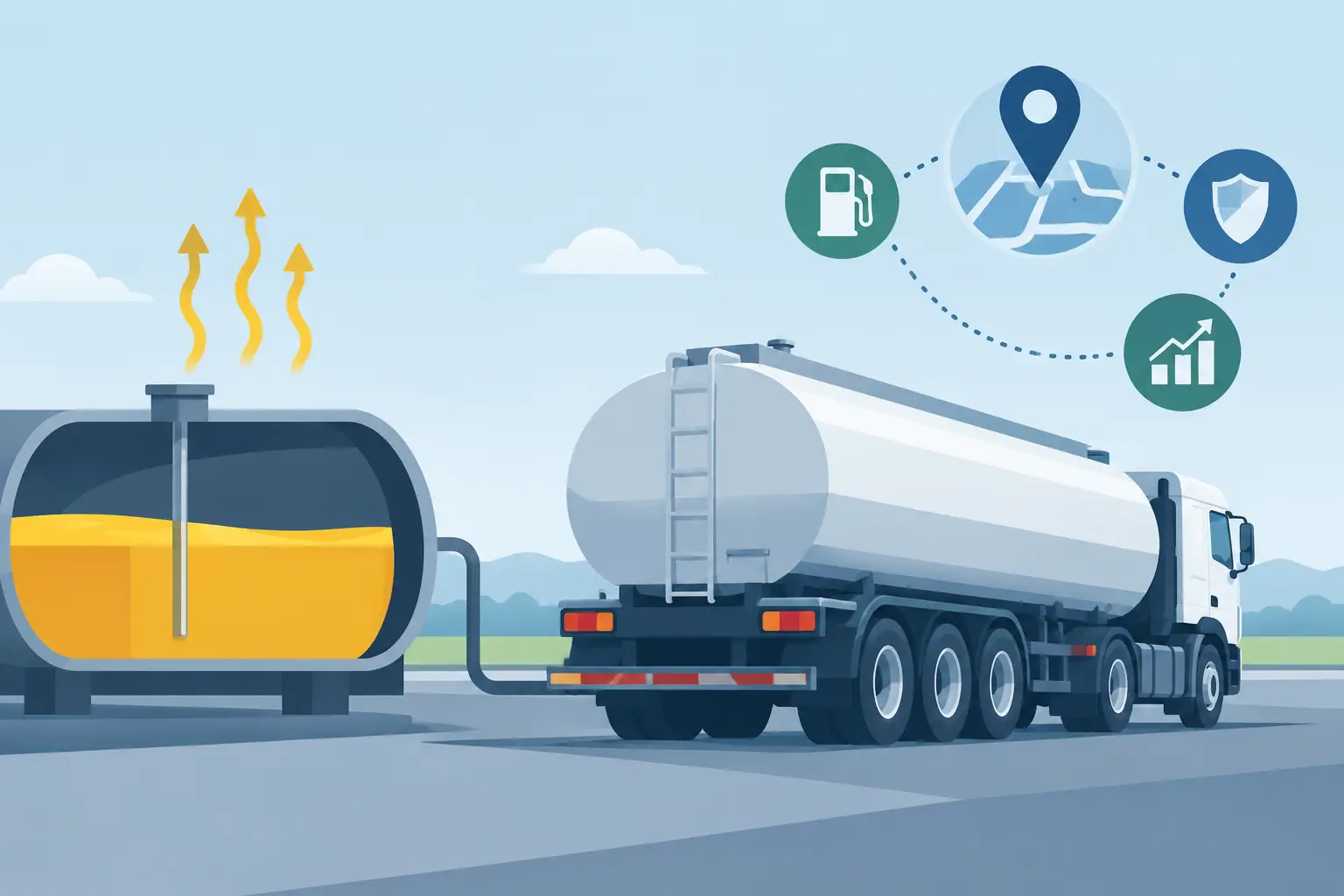
Why Tanks Lose Fuel and What Fleets Can Do
A tank can appear to lose fuel long before anyone sees a puddle, smells vapour or finds a damaged hose. That is why tanks lose fuel is not a question with one answer. For fleet operators, the real issue is whether every litre delivered, stored and dispensed can be explained with evidence.
A small unexplained variance repeated across several depots, bowsers or shifts becomes a material cost. It also creates exposure: unplanned downtime, environmental risk, disputes over delivery volumes and weak accountability at the pump. The right response is not to guess. It is to separate physical loss from measurement error, process gaps and unauthorised dispensing.
Why tanks lose fuel: the main causes
Temperature changes and apparent volume loss
Fuel expands when warm and contracts when cold. A tank dipped on a cold morning may show fewer litres than it did after a warm afternoon, even when no fuel has left the tank. This is especially relevant where stock is measured manually, deliveries are received at a different temperature, or records compare raw litres rather than temperature-compensated volume.
Diesel is less prone to evaporative loss than petrol, but temperature still affects its measured volume. A changing level is not automatically proof of theft or a leak. It is a reason to check the timing, temperature, tank chart and measuring method before escalating the issue.
Water can complicate the picture too. Condensation, poor fill-cap seals or contaminated deliveries may introduce water into a tank. Water takes up volume, affects fuel quality and can distort a manual dip if the operator is not using water-finding paste and a consistent process.
Leaks, damaged equipment and overfills
Physical loss is the most urgent category because it can quickly become a safety and environmental incident. Corroded tanks, failing gaskets, cracked pipework, worn hoses, damaged nozzles and loose fittings can all release fuel. Underground pipework and slow leaks are particularly difficult to spot, while a leak on a mobile fuel unit may only show itself after travelling over rough ground.
Overfills are another common source of loss. If an operator relies on an inaccurate gauge, does not monitor a delivery, or fills beyond safe working capacity, fuel can escape through vents or spill points. A tank’s vents, spill containment and fill connections deserve the same inspection discipline as the pump itself.
Daily visual checks matter, but they are not enough on their own. A gradual loss may leave no obvious evidence. Trends in inventory reconciliation often reveal a problem before it is visible on site.
Delivery discrepancies and poor receiving controls
Not every litre billed to a site necessarily reaches the tank. Delivery discrepancies can result from supplier error, incorrect paperwork, a wrong tank selection, meter variation, or a receiving process that does not capture accurate before-and-after levels.
The practical control is to reconcile each delivery against the tank level, delivery documentation and expected available capacity. If the site records only the invoice total, without a documented opening level and verified closing level, it has little basis for challenging a variance.
This does not mean every difference indicates a supplier problem. Tank geometry, temperature and meter tolerances all create acceptable variation. The key is to define a realistic tolerance for each tank and investigate repeated or material exceptions rather than accepting every mismatch as normal.
Metering errors and manual recording gaps
A dispensing meter measures flow, not intent. If it is out of calibration, worn, damaged or incorrectly configured, its reading may not match the volume that has actually left the tank. A faulty pulse meter, a bypassing valve or an inaccurate totaliser can create persistent discrepancies that look like shrinkage.
Manual records introduce another risk. Handwritten logs can be incomplete, delayed, misread or entered against the wrong vehicle. Operators may round figures, forget to record a dispense during a busy shift, or use a shared access key that makes responsibility impossible to trace. The result is an inventory number that looks precise but cannot be audited.
Regular meter proving and calibration are essential, particularly on high-volume dispensers and mobile fuel units. But calibration alone will not fix weak transaction records. Fleet managers need to know who dispensed, into which asset, when it happened and how many litres were issued.
Unauthorised dispensing and theft
Unauthorised dispensing is often the hardest source of loss to quantify because it can be disguised as legitimate activity. A pump left accessible after hours, a shared PIN, an unreturned key or a paper log signed after the fact all create opportunities for fuel to leave without a reliable trail.
The risk is not limited to deliberate theft. A driver may fuel an unapproved vehicle, select the wrong product, overfill an asset or dispense for a contractor without authorisation. Each event weakens cost allocation and makes fuel consumption reporting less credible.
Access control changes the equation. When the pump is locked by default and each dispense requires an authorised user identity, the organisation moves from assumption to evidence. Permissions can reflect roles, locations, fuel types and operating hours, while managers can remove access immediately when an employee changes duties or leaves.
Find the point where control breaks down
The fastest way to diagnose a fuel variance is to follow the fuel journey: delivery into storage, inventory held in the tank, fuel dispensed through equipment, and consumption recorded against the asset. A gap at any point can create loss, or the appearance of loss.
Start with a defined reconciliation routine. Compare opening stock plus deliveries against closing stock plus recorded dispenses. Do it consistently – daily for high-throughput locations, and at a frequency that matches the risk for lower-volume sites. Use the same measurement method, account for known temperature effects where possible, and document any adjustments.
Then look for patterns. Does variance occur after a particular delivery company arrives? Does it increase on night shifts, at one depot, or when a certain mobile unit is operating? Does a specific dispenser consistently report more fuel out than the tank appears to lose? Patterns turn an unexplained number into a focused investigation.
A useful investigation should also distinguish between a one-off event and a systemic weakness. A damaged hose needs immediate repair. Repeated manual-entry errors point to a process problem. Repeated after-hours fuel movement points to an access-control problem.
Build accountability into every dispense
Strong fuel control does not need to mean more paperwork for operators. In fact, the best systems reduce manual administration by creating the transaction at the point of dispense.
A secure process links the user, vehicle or asset, pump, fuel type, date, time and litres issued in one record. That record should be available to operations and finance without waiting for paper sheets to be collected and re-entered. It should also support exceptions: an unusual fill volume, a fuel issue outside approved hours, or a dispense into an asset with no expected need for fuel.
This approach is particularly valuable for multi-site fleets and mobile fuel operations. Centralised permissions prevent a former employee’s access from remaining active at another location. Centralised reporting lets managers compare sites using the same standards, rather than relying on each depot’s version of a manual process.
Manage Every Drop supports this model with smartphone-authorised dispensing and cloud-based transaction records, helping fleets secure pumps while creating an auditable record for each fuel issue. The objective is straightforward: make the authorised action the easy action, and make exceptions visible quickly.
Prevention is cheaper than investigation
There is no single control that eliminates every cause of fuel loss. Physical assets still need inspection and maintenance. Tanks need sound inventory practices. Meters need calibration. Deliveries need to be checked. Yet the most effective programmes connect these controls instead of treating them as separate tasks.
Set clear variance thresholds by tank and location. Investigate exceptions promptly while the relevant people, vehicle and delivery details are still identifiable. Restrict pump access to approved users, remove permissions without delay, and avoid shared credentials. Most importantly, reconcile fuel as an operating discipline, not as a month-end finance exercise.
Every unexplained litre is a question about process, equipment or accountability. When each dispense is authorised, recorded and reconciled, that question becomes far easier to answer before a small variance becomes a recurring cost.



Post a comment