
Essential Mobile Tanker Equipment for Secure Delivery
A mobile tanker can be a major operational advantage: fuel, lubricants or other critical fluids reach the asset rather than taking vehicles out of service. But that advantage disappears quickly when a delivery cannot be verified, a hose fails, stock goes missing, or an unauthorised person operates the pump. Essential mobile tanker equipment must therefore do more than move product. It must protect people, prevent releases and create a defensible record of every dispense.
For fleet operators, the right specification is not simply a tanker body and a pump. It is a controlled dispensing system built around the fluid being carried, the working environment, the delivery volume and the level of accountability the business requires.
Start with the fluid and the duty cycle
There is no universal tanker specification. Petrol, diesel, lubricants, waste oils, aviation fuels and diesel exhaust fluid each have different handling requirements, compatibility considerations and risks. The first question is not which equipment is cheapest or most familiar. It is what the fluid demands, how often the tanker will dispense, and where it will operate.
A tanker serving a quarry, construction site or remote fleet yard may need a different chassis, hose arrangement and filtration approach from one making controlled deliveries at an airport or commercial depot. Temperature, terrain, expected pumping hours, delivery point access and the need to meter small versus high-volume transactions all matter.
This is also where operators should separate necessary capacity from useful capacity. A larger tank can reduce replenishment trips, but it increases vehicle weight, affects manoeuvrability and may reduce the ability to serve restricted sites. The most productive unit is not always the largest one. It is the one that can safely complete its planned work without creating unnecessary downtime or compliance exposure.
The essential mobile tanker equipment checklist
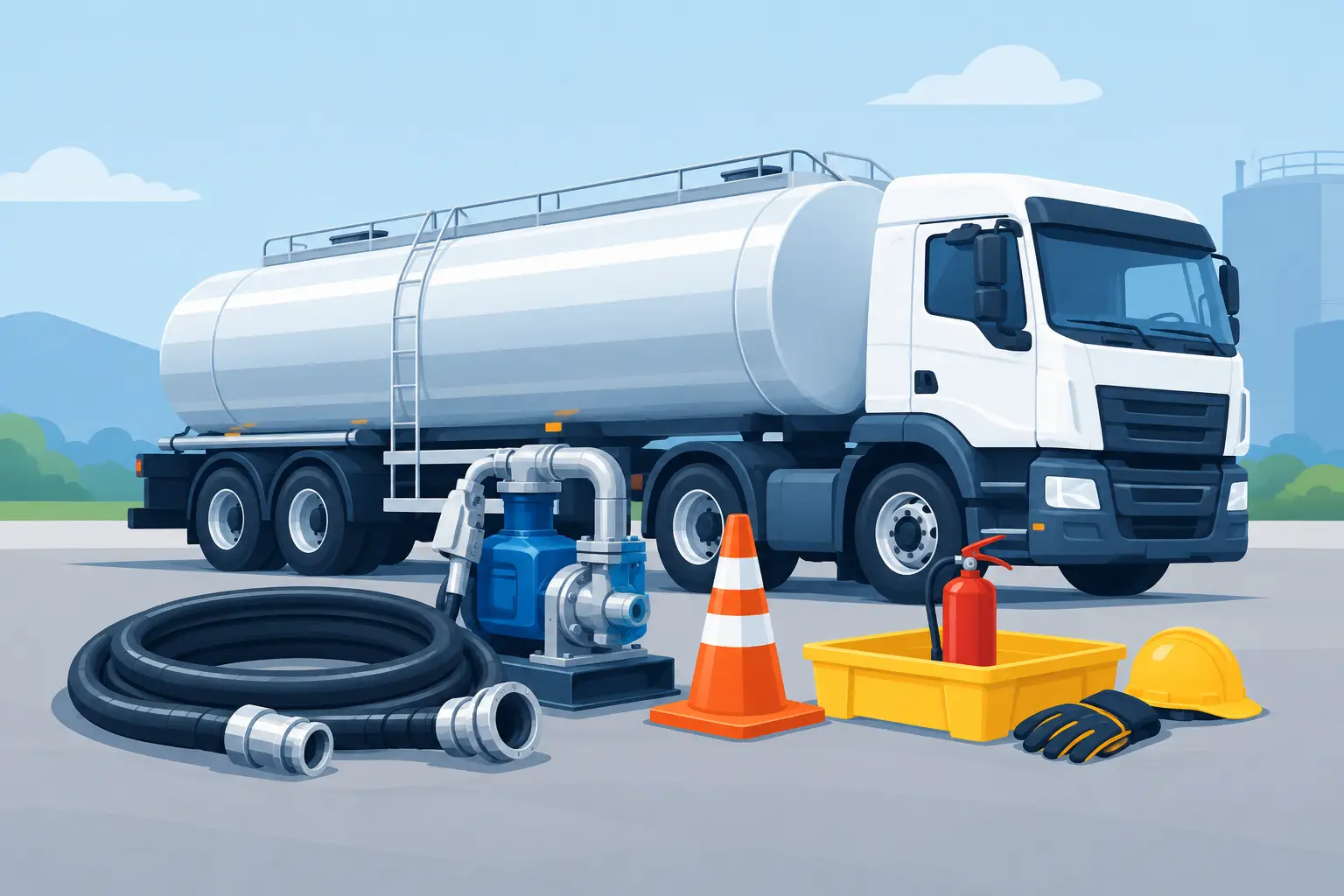
The tanker, pump and plumbing are the foundation, but safe mobile dispensing depends on several systems working together. A well-specified unit typically includes the following equipment.
- A correctly rated tank and compartment system suited to the product, including secure fill points, vents, level indication and protection against overfill. Tank construction, seals and fittings must be compatible with the fluid, not merely available off the shelf.
- A reliable transfer pump and filtration system sized for the required flow rate and duty cycle. Clean product matters. Filters help protect customer equipment and give operators a practical warning when contamination or poor housekeeping needs attention.
- Metering and dispensing hardware including a calibrated meter, delivery hose, nozzle and breakaway protection where appropriate. The meter is particularly important because it turns a physical transfer into a measurable transaction.
- Safety and spill-response equipment such as an emergency stop, fire extinguishers, spill kit, bonding or earthing equipment where required, drip containment, high-visibility markings and suitable personal protective equipment.
- Hose management and vehicle access equipment including reels or secure hose storage, hose guides, safe access steps, handholds and lighting for early-morning or night work. Hoses dragged across a yard or left unsecured are a safety problem before they become a maintenance cost.
- Secure access control and transaction capture that ties every dispensing event to an authorised user, vehicle or asset, time, location and quantity. This is the difference between knowing the tanker was used and knowing exactly what happened.
Not every operation needs every option. A low-volume lubrication vehicle may need a different arrangement from a high-throughput diesel bowser. Yet the principle stays the same: equipment should make the correct action easier and the unsafe or unaccountable action harder.
Safety equipment should be designed into the workflow
Safety cannot depend on an operator remembering a paper procedure during a busy shift. Emergency shut-offs need to be accessible and clearly marked. Hoses and nozzles need to be inspected before defects become leaks. Spill kits need to be complete, visible and matched to the products carried, not buried behind tools or empty containers.
Fire prevention and static control also deserve attention. Requirements vary by fuel type, location and local regulation, so operators should verify the applicable transport, workplace and environmental rules for every territory they serve. For flammable liquids, bonding and earthing procedures, ignition-source control and appropriate electrical equipment are operational requirements, not box-ticking exercises.
Driver training is equally essential. Operators should understand product hazards, pre-use checks, emergency actions, safe parking, hose routing and what to do when a customer asset or delivery point is unsuitable. The best equipment cannot compensate for a rushed decision at the point of dispense.
Measurement is only valuable when it is trusted
A mechanical or electronic meter provides volume, but volume alone does not settle an account. Fleet managers still need to know who received the fluid, which asset was filled, when it happened and whether the dispense was authorised.
Paper tickets and handwritten logs create avoidable gaps. They can be late, incomplete, illegible or difficult to reconcile against tanker inventory. A driver may complete paperwork accurately, but finance and operations teams still spend time matching it to stock movements, vehicle records and invoices.
A cloud-connected access-control system closes that gap at the pump. With smartphone-based authorisation, only approved personnel can start dispensing. Each transaction can be captured in real time with the user identity, date and time, quantity and assigned asset details. Permissions can be added or removed centrally, which is especially valuable when drivers, contractors or site access change at short notice.
For mobile operations, this control is not a luxury. A tanker is effectively a moving fuel store. If access is not controlled, any loss can be difficult to locate and even harder to recover. Manage Every Drop uses FluidSecure™ to bring the same level of accountability to mobile dispensing that many operators expect at a fixed fuel island, without the complexity of traditional pedestal-based systems.
Protect the product from contamination and loss
Product loss does not always look like theft. It can appear as unexplained variances, repeat filter blockages, contaminated tanks, over-delivery, poor hose discipline or unrecorded internal transfers. The operational cost includes more than the price of the missing litres. It can include equipment damage, emergency call-outs, missed work and disputes with customers or internal departments.
Good tanker design helps prevent these losses. Lockable compartments, protected controls, secure nozzle storage and clearly separated product lines reduce opportunities for mistakes and unauthorised use. Correct filtration and routine tank cleaning protect product quality. Calibrated meters and stock checks make variances visible while they are still manageable.
Digital records add the context that physical security cannot provide. If inventory does not reconcile, managers can review actual dispensing activity rather than relying on recollection. Patterns such as unusual after-hours activity, repeated top-ups or volumes that do not align with asset use can be investigated early.
Build inspection and maintenance into daily operation
Mobile tanker equipment works hard. Vibration, road debris, weather, repeated hose handling and long pumping hours place continual stress on components. Waiting for a visible leak or a pump failure is expensive maintenance planning.
Daily checks should cover hose condition, couplings, nozzle operation, pump performance, meter condition, filter indicators, emergency-stop function, signage, extinguishers and spill equipment. Drivers should also look for evidence of leaks beneath the vehicle, damaged locks, loose fittings and changes in fluid level that do not match recorded deliveries.
Planned servicing should follow the equipment manufacturer’s requirements and the operator’s actual duty cycle. High-use units may need more frequent attention than a calendar-only schedule suggests. Keep calibration, inspection and repair records alongside dispensing data. When a customer questions a delivery or an auditor requests evidence, a complete record is far stronger than a verbal assurance.
Specify for accountability, not just delivery
The cheapest mobile tanker setup can look attractive at purchase stage, particularly when a business is adding capacity quickly. But low initial cost can be erased by manual reconciliation, product loss, preventable repairs and time spent chasing missing delivery records.
A better purchasing decision considers total operating cost. Ask whether the system can control access, identify the person dispensing, record the transaction automatically, support inspections and scale across multiple vehicles or sites. Consider the support model too. Equipment that cannot be maintained promptly is not truly available equipment.
The goal is straightforward: every litre or fluid dispense should have an authorised purpose, a named operator and a record that can be checked without searching through paperwork. When tanker equipment is specified around that standard, mobile delivery becomes easier to manage, safer for operators and far more defensible for the business.
The next time a tanker is being built, replaced or upgraded, treat the dispensing controls with the same seriousness as the tank and pump. Product in motion still needs to be accounted for – and the right equipment makes that accountability practical on every stop.


Post a comment