



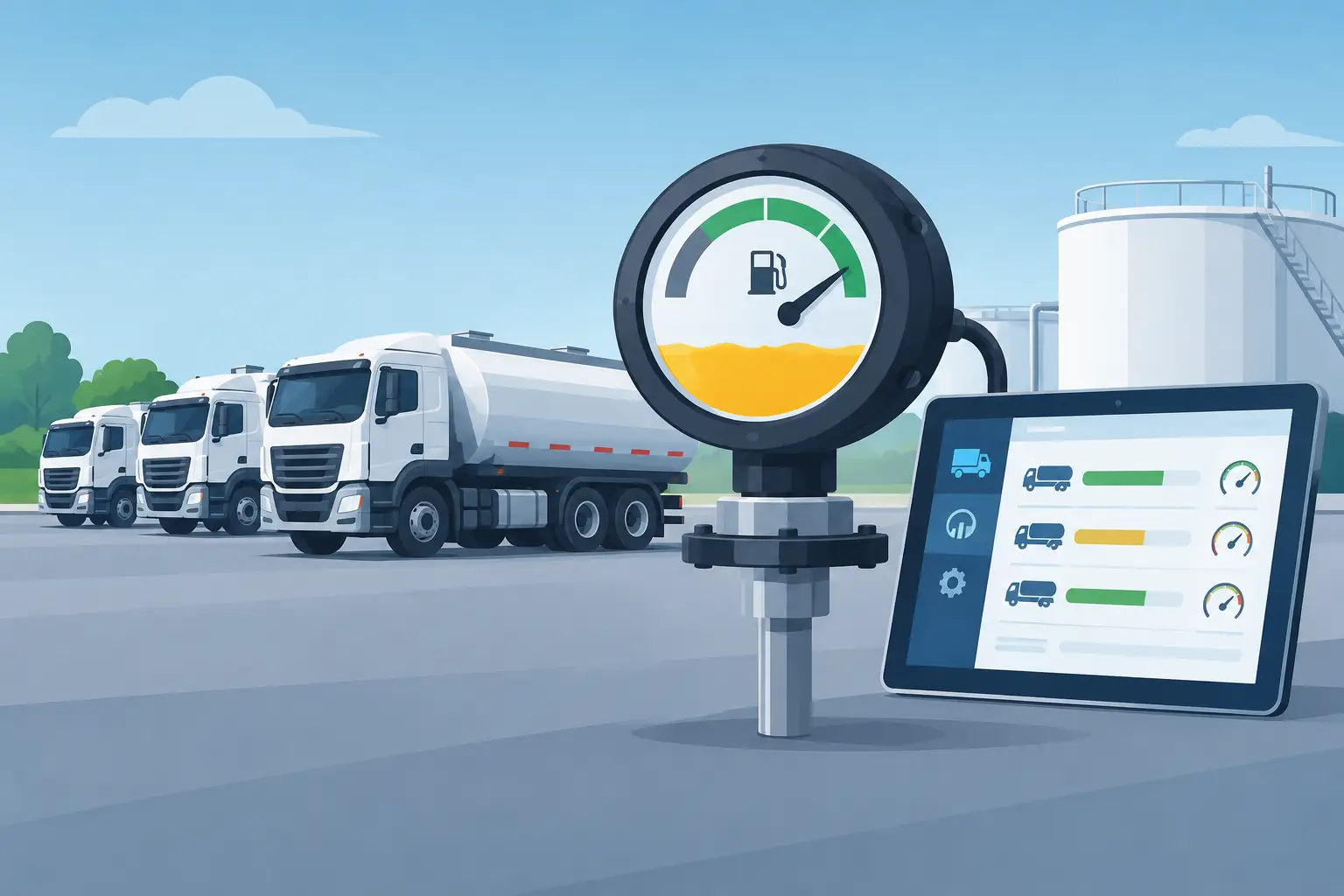
Best Tank Gauges for Better Fleet Fuel Control
A tank can look full at the start of a shift and still leave operations short by mid-afternoon. That is what makes the best tank gauges more than a maintenance purchase. For fleets that store diesel, petrol, DEF, oils or other operational fluids, accurate tank visibility protects uptime, purchasing decisions and the integrity of every dispense record.
The right gauge tells you what is in the tank. The right fuel management approach also tells you who removed it, which vehicle received it and whether the stock position makes sense. Those are related jobs, but they are not the same job. Understanding the difference is the first step towards choosing equipment that delivers control rather than another number to check.
What makes a tank gauge right for fleet operations?
A domestic-style level indicator may be enough for a small, low-risk tank that is checked occasionally. Fleet fuel storage has higher stakes. A missed delivery, an undetected leak or an unexplained variance can interrupt work, inflate fuel costs and create difficult questions during an audit.
The best choice depends on the fluid, tank construction, operating environment and the decisions your team needs to make from the data. A gauge for a bulk diesel tank at a depot has different requirements from one on a mobile fuelling lorry or at a remote airfield. Accuracy matters, but reliability, data access and serviceability matter just as much.
Look for a system that provides a usable reading across the working range of the tank, not merely an approximate percentage. It should cope with temperature changes, vibration, condensation and the normal wear of an industrial site. If the tank is outdoors, verify environmental protection and communications performance rather than assuming a consumer-grade monitor will hold up.
Most importantly, decide what action the reading should trigger. If staff only need a local visual check before ordering a delivery, a simple mechanical solution may be appropriate. If several sites need central oversight, automatic replenishment planning or reconciliation against dispensing activity, remote telemetry is usually the stronger operational choice.
Best tank gauges by monitoring method
Mechanical float gauges
Float gauges use a float inside the tank connected to a dial or display. They are familiar, relatively inexpensive and easy to understand at the point of use. For straightforward applications, they can provide a useful quick reference without power, software or a subscription.
Their limitation is precision. Floats can stick, linkages can wear and the reading is often too broad to support reliable reconciliation. They also require someone to be physically present, which makes them a weak fit for unattended sites or multi-location fleets. Treat a mechanical gauge as a local indicator, not as proof of inventory.
Hydrostatic level sensors
Hydrostatic sensors measure pressure created by the fluid column and calculate level from that pressure. They can provide dependable continuous readings and work well where tank geometry is known and the sensor is correctly specified for the fluid.
This method can be effective for fixed tanks, but installation quality is critical. Changes in fluid density, sensor drift, blocked ports or incorrect calibration can affect results. It is worth selecting a supplier that can support commissioning and periodic verification, especially when readings will be used for stock control or environmental reporting.
Ultrasonic gauges
Ultrasonic gauges sit at the top of the tank and use sound waves to measure the distance to the liquid surface. Because they are non-contact, they can reduce exposure to corrosive or contaminated fluids and simplify servicing in suitable installations.
They are not universal. Foam, vapour, internal obstructions and irregular tank shapes can interfere with the signal. For clean fuel tanks with a clear measurement path, ultrasonic technology can be a practical option. For more demanding conditions, ask for evidence that the sensor is designed for the tank and product in question.
Radar level gauges
Radar gauges use electromagnetic signals rather than sound. They are generally more tolerant of vapour, temperature variation and challenging process conditions, making them a strong option where high accuracy and dependable remote readings are required.
The trade-off is cost. Radar is often more expensive than basic mechanical, ultrasonic or pressure-based alternatives. That investment is easier to justify on high-volume tanks, sites where stockouts are costly, or locations where staff cannot safely and routinely inspect the tank.
Remote telemetry systems
Remote telemetry combines a level sensor with a communications device and online dashboard. It gives authorised users a current view of inventory without travelling to the tank, and it can issue alerts for low stock, unusual consumption or sudden level movement.
For fleet operators, telemetry becomes particularly valuable when it supports decisions rather than simply sending alerts. A useful platform should make it easy to compare current stock with expected usage, delivery records and dispensing transactions. If your team is still copying readings into spreadsheets and chasing paper tickets, the data is not doing enough work.
Accuracy is only useful when it can be reconciled
A highly accurate tank level reading does not, by itself, prevent fuel loss. It can show that stock has changed, but it cannot identify whether the change came from an authorised vehicle, a delivery discrepancy, a leak, evaporation allowance or unauthorised dispensing.
That is why the strongest control model connects inventory visibility with dispense accountability. Tank data establishes what should be available. A secure pump authorisation system records each issue against a verified user, vehicle or asset. Delivery information completes the picture. When those three records align, finance and operations can reconcile stock quickly and investigate exceptions before they become routine loss.
For example, a site may see a 1,500-litre decline over two days. A gauge confirms the physical movement, but authorised transaction data shows whether 1,450 litres were legitimately issued to fleet vehicles. The remaining variance can then be assessed against deliveries, equipment calibration and potential loss. Without that transaction trail, the team is left with assumptions.
Manage Every Drop supports this wider accountability model by pairing secure, smartphone-authorised dispensing with cloud-based transaction records. A compatible tank monitoring strategy can give fleet managers the inventory context needed to act on those records with confidence.
Questions to ask before buying a gauge
The best tank gauge is one that fits your operating risk, not the one with the longest specification sheet. Before committing, establish the answers to these questions:
- What fluids will be measured, and are they compatible with the sensor materials?
- What tank type, height, shape and internal fittings must the gauge accommodate?
- How accurate must the reading be for ordering, compliance and reconciliation?
- Does the site have reliable power and mobile or network coverage?
- Who will calibrate, inspect and maintain the equipment?
- Can the data be viewed across all locations and exported into existing reporting processes?
These questions expose common hidden costs. A low purchase price may become expensive if technicians must visit remote tanks to collect readings, replace unreliable components or manually correct inconsistent data. Equally, a premium sensor may be unnecessary if a local, visual indication genuinely meets the operational need.
Avoid these common selection mistakes
The first mistake is choosing by percentage accuracy alone. A sensor can be accurate in laboratory conditions yet perform poorly when installed on a sloped base, inside an irregular tank or around vapour and foam. Ask how the proposed system has performed in applications similar to yours.
The second is overlooking dead stock and usable volume. A tank may show 10 per cent remaining, but that does not necessarily mean 10 per cent is available to the pump. Establish the minimum operating level, suction arrangement and reserve volume so low-level alerts reflect real risk.
The third is treating a gauge as a security device. Gauging identifies inventory movement. It does not lock a pump, authenticate a driver or create an auditable dispensing record. Where theft, misuse or unexplained variance is a concern, combine level monitoring with access control at the point of dispense.
Finally, do not accept a system that leaves data trapped in a single device or dependent on one employee’s routine. The value of connected monitoring comes from timely, shared visibility. Site managers, operations teams and controllers should be working from the same trusted information.
Put tank data to work
Start by defining the outcome you need: fewer run-outs, tighter purchasing, faster reconciliation, better environmental oversight or stronger loss prevention. Then select a gauge technology that can reliably support that outcome in your actual site conditions.
The most effective fuel operations do not rely on a weekly glance at a dial. They create a clear chain from tank inventory to authorised dispense to financial record. When every litre has a visible place in that chain, teams can spend less time explaining variances and more time keeping vehicles moving.



Post a comment