

Fuel Cards vs On-Site Controls
If your fuel spend looks reasonable on paper but the numbers still do not quite reconcile, the issue is often not price per litre. It is control. That is why the real conversation around fuel cards vs on-site controls matters for fleet operators, airports, haulage firms and mobile fuelling teams that need every dispense event tied to a person, a vehicle and a time.
Fuel cards vs on-site controls: what is the real difference?
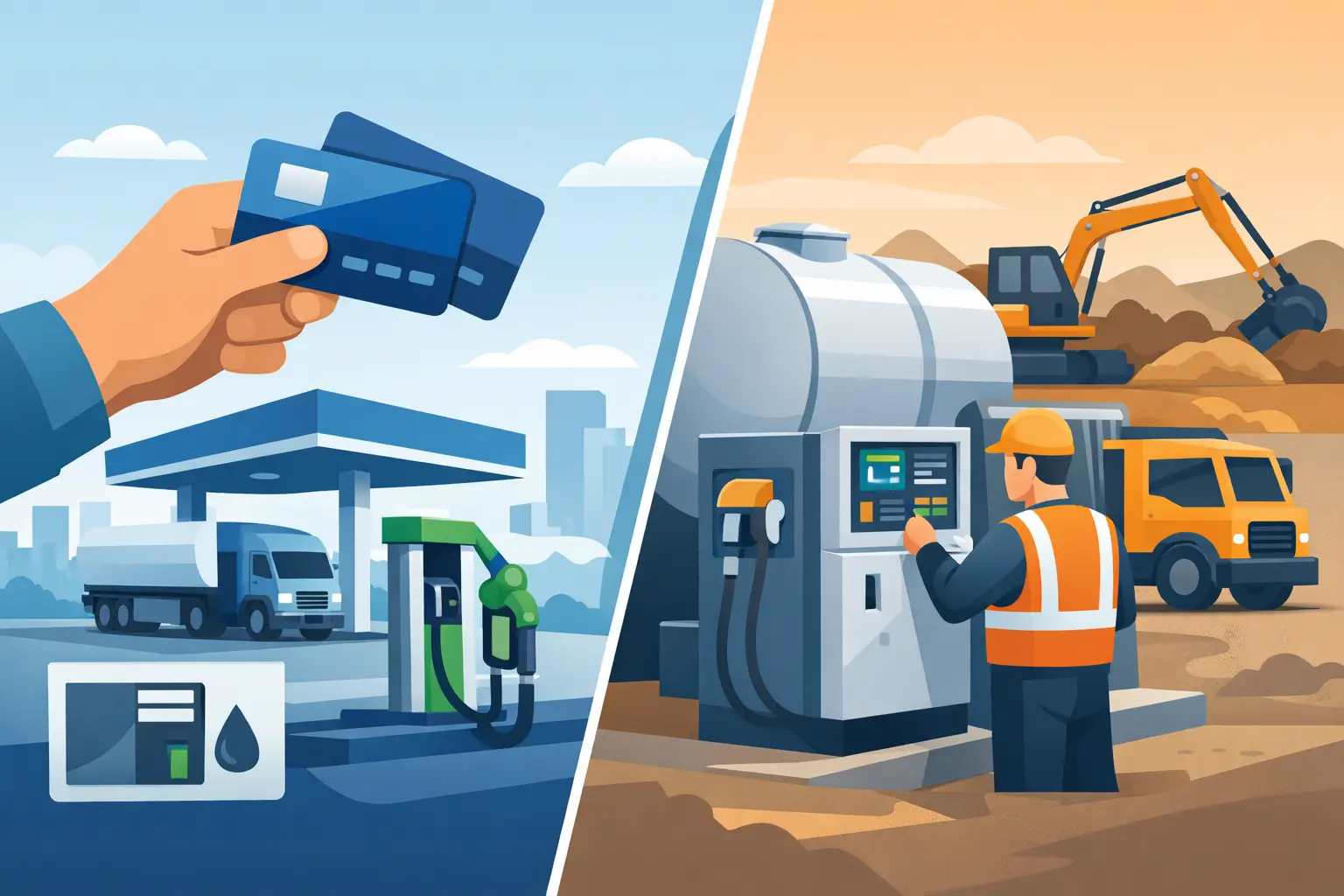
Fuel cards are built for buying fuel at third-party forecourts. They can be highly useful when drivers need flexibility on the road, when routes vary, or when your business does not store fuel on-site. They also give finance teams a cleaner payment trail than cash or petty expenses.
On-site controls solve a different problem. They govern access to your own tanks, pumps and mobile dispensing assets. Instead of simply recording that a purchase happened, they control whether a dispense can happen at all, who is allowed to dispense, what asset they are fuelling and when that transaction reaches your records.
That distinction matters. A fuel card helps you pay and report. An on-site control system helps you prevent unauthorised use before fuel leaves the tank.
For many operators, this is not an either-or argument in the abstract. It comes down to where fuel is dispensed, how much shrinkage risk exists, how quickly you need transaction visibility and whether manual reconciliation is draining time from operations and finance.
Where fuel cards work well
Fuel cards are a sensible fit for dispersed fleets that buy mostly from retail or commercial filling stations. If your drivers cover long routes, work in changing locations or rarely return to base, cards provide practical coverage and a familiar workflow.
They can also support policy enforcement to a point. Depending on the provider, you may be able to set spend limits, time-of-day rules, product restrictions and transaction alerts. That is better than handing over a general payment card and hoping for the best.
But a card is still a payment instrument. Even with controls, it does not physically lock a pump, verify the exact vehicle at your own site or stop someone from using fuel already stored in your tank unless there is another layer of equipment and authorisation in place.
This is where some fleets run into a blind spot. They assume a cleaner invoice means tighter fuel control. It does not always. Cards improve payment discipline. They do not automatically eliminate site-level loss, internal misuse or the delay between a dispense and a reconciled record.
Where on-site controls deliver more value
If you own fuel inventory, operate a yard tank, refuel plant equipment, manage airport ground assets or run a mobile fuel lorry, on-site controls deserve serious attention. In these environments, the cost of weak access control is rarely limited to fuel loss alone. It can also affect maintenance records, tax reporting, compliance and asset availability.
A modern on-site control system secures the pump so only authorised users can dispense. It logs the transaction automatically, links it to the user and asset, and sends the record to the cloud in near real time. That creates accountability at the point of issue rather than after the fact.
For operations teams, that means less dependence on notebooks, keypad codes shared across shifts or end-of-week spreadsheet corrections. For finance and procurement, it means a far cleaner audit trail. For management, it means quicker answers when litres dispensed do not match expectations.
The operational difference is straightforward. With a card-led model, the transaction is often the starting point for investigation. With on-site controls, the authorisation itself is part of the control framework.
Security and accountability: the deciding factor for many fleets
When decision-makers compare fuel cards vs on-site controls, security usually settles the debate. Not because cards have no security, but because the type of security is different.
A fuel card can confirm a valid card was used. In some cases, it can add a PIN, driver ID or registration prompt. That is helpful. Yet cards are still vulnerable to behaviours that sit outside the system itself, such as card sharing, weak PIN discipline or purchases that appear valid but do not align with operational reality.
An on-site control platform is designed to secure the asset at the pump. Authorisations can be granted or removed quickly. Transactions are tied directly to who dispensed, what was dispensed and where it happened. If a driver leaves, permissions can be revoked immediately. If a contractor needs temporary access, that can be managed without issuing a general site code for everyone to know.
This level of accountability is especially valuable across multiple depots or mixed fixed and mobile operations. Standard rules, central visibility and consistent records reduce the gaps that tend to grow when each site manages fuelling in its own way.
The hidden cost question is not just hardware
Some buyers hesitate at on-site systems because they assume any forecourt control technology will be expensive, disruptive and difficult to maintain. That may have been true of older pedestal-heavy setups with significant site infrastructure and service requirements.
Modern cloud-connected systems have changed that calculation. Lower hardware complexity, quicker installation and central software updates can reduce both up-front cost and ongoing maintenance. The more sites you manage, the more that simplicity matters.
By contrast, fuel cards can look inexpensive because the hardware burden is minimal. But if your business stores fuel, the hidden costs often sit elsewhere – stock loss, manual reconciliation, delayed exception handling, unauthorised access and the administrative time spent matching card reports to actual site activity.
That is why cost should be measured as total cost of control, not just the price of getting fuel paid for. A cheaper process that leaves you exposed to loss is not really cheaper.
Reporting, reconciliation and operational speed
The strongest case for on-site controls often appears after implementation, when teams realise how much time had been disappearing into manual work. Paper logs go missing. Driver handwriting is unclear. Vehicle numbers are entered incorrectly. Someone has to reconcile tank levels, issue records and usage by site.
A controlled, cloud-based system removes much of that friction. Transactions are captured automatically and made available through a dashboard, creating a live operational picture instead of a backward-looking paperwork exercise. Exceptions stand out faster. Inventory becomes easier to monitor. Month-end becomes less painful.
Fuel cards do offer reporting, and for off-site purchasing that reporting is useful. But reporting alone is not the same as a full chain of custody for your own fuel stock. If your priority is auditable dispensing from assets you own, on-site controls are typically the stronger fit.
The best answer for many operators is a hybrid model
There is no value in pretending every fleet should choose one and reject the other. Many operations need both.
A regional haulage firm may use fuel cards for drivers on long-distance routes while controlling depot tanks with on-site authorisation. An airport may secure on-site fuel and fluid dispensing for ground support equipment but still issue cards for certain road vehicles. A contractor with mobile refuelling capability may require strict access controls for the bowser while keeping fleet card arrangements for travel beyond its normal operating area.
This is the practical view. Use fuel cards where third-party network access matters. Use on-site controls where your business owns the fuel, the pump or the compliance risk.
That combination gives you flexibility without giving away accountability.
How to choose between fuel cards vs on-site controls
Start with three questions. Where does most of your fuel actually get dispensed? Who needs access, and how often does that change? How confident are you that every litre leaving your tanks can be traced without manual effort?
If most fuelling happens away from base, cards may lead. If most fuelling happens from your own tanks or mobile units, on-site controls should move to the front of the queue. If your answer is mixed, your system should be mixed too.
It also helps to be honest about current pain points. If theft, shrinkage, missing records or authorisation gaps are ongoing issues, adding better payment reporting will not solve the root cause. You need control at the point of dispense.
That is where a provider with a security-first, cloud-connected approach can make a measurable difference. Manage Every Drop supports fleets that need to secure pumps, document every transaction and reduce loss without the complexity of legacy systems.
The right choice is the one that gives your team confidence every time fuel moves – not just a tidy invoice after it has already gone.


Post a comment