
Manual Fuel Logs vs Cloud Records
A missing 200 litres rarely announces itself at the pump. It usually appears later – in a spreadsheet that does not balance, a tank level that looks wrong, or a month-end review where no one can say with confidence who dispensed what, when, and why. That is the real difference in manual fuel logs vs cloud records. One gives you a paper trail that depends on people remembering to fill it in correctly. The other gives you a live operational record tied to each dispense event.
For fleet managers, operations leaders and finance teams, this is not a paperwork debate. It is a control question. If fuel is one of your largest operating costs, the way you record dispensing activity directly affects loss prevention, reconciliation speed, compliance, and trust in your numbers.
Manual fuel logs vs cloud records at the operational level
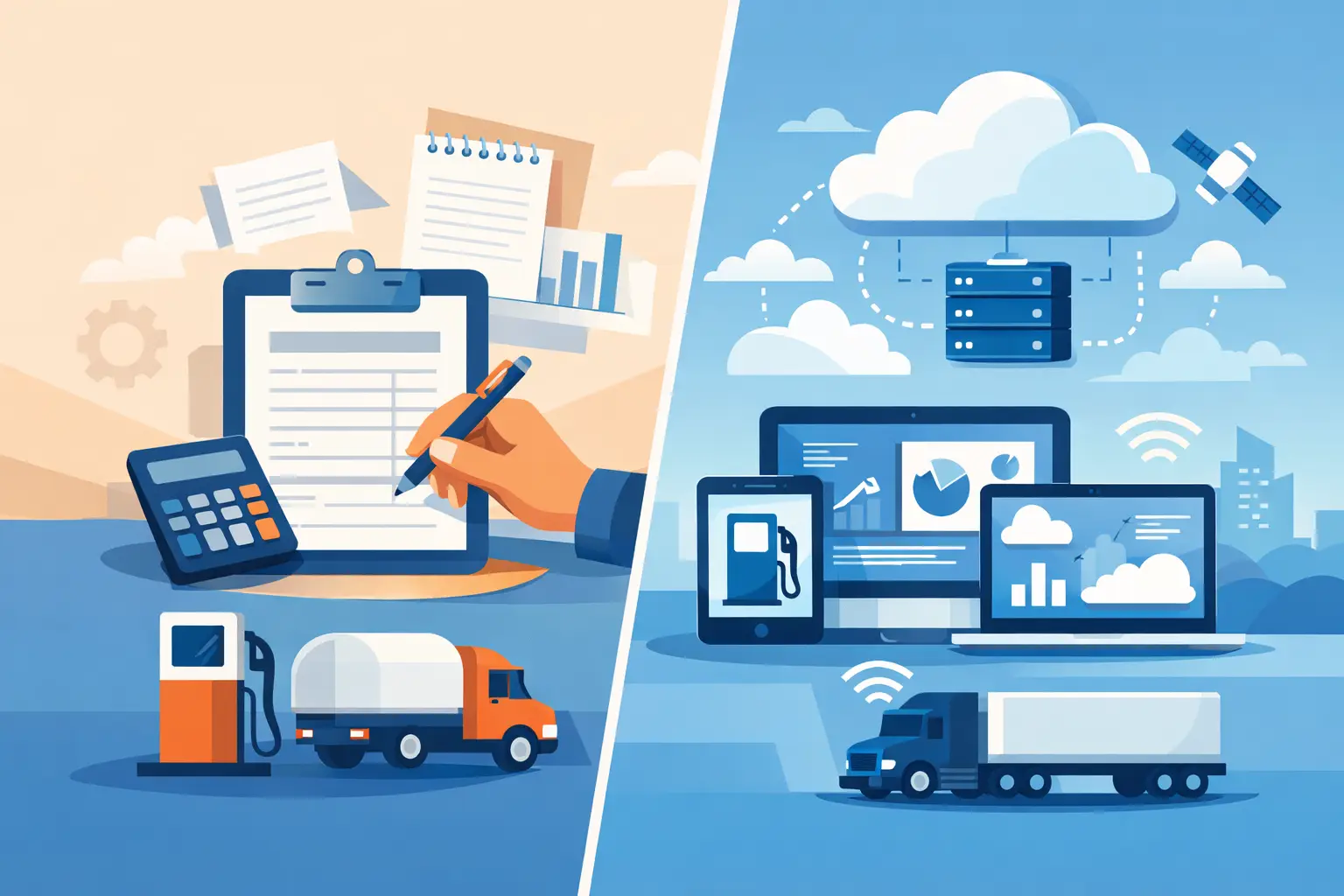
Manual fuel logs still exist for a simple reason: they are familiar. A clipboard by the tank, a notebook in the mobile fuelling unit, or a spreadsheet updated at the end of a shift can feel low cost and easy to start with. For a very small operation with one site, one tank and a tight-knit team, manual logging may appear perfectly serviceable.
The problem is that manual systems rely on consistent human behaviour every single time fuel is dispensed. Drivers need to write down the right registration, unit number, litres, date, time and perhaps odometer or hour meter. Supervisors need to read the handwriting, check the entries, and transfer the information into another system for reporting or reconciliation. If anything is missed, guessed, delayed or entered twice, the record is weakened.
Cloud records work differently. The dispense event itself creates the record. Authorisation happens before fuel flows, user identity is captured, transaction data is stored automatically, and reporting updates without someone re-keying notes from paper into a spreadsheet. That changes the quality of the data and the speed at which you can act on it.
This is why many fleets move away from manual logs long before they have a formal compliance issue. They simply get tired of running an expensive operation on delayed, incomplete information.
Where manual logs still look attractive
It is worth being fair here. Manual logs do offer a few short-term advantages. They have almost no upfront process change, staff already understand them, and they can seem flexible if your operation is informal. If a site has low fuel volume and little turnover in personnel, paper records may feel adequate for day-to-day use.
But those advantages fade as soon as the operation becomes busier, more distributed or more accountable. Add a second yard, a mobile bowser, rotating drivers, subcontractors, or a requirement to explain variances to finance, and the weaknesses show quickly. The lower apparent cost of manual logging often hides higher labour, weaker control and more exposure to fuel loss.
That trade-off matters. A system is not cheap if it saves money on hardware but quietly loses money in shrinkage, admin time and poor visibility.
The hidden cost of paper and spreadsheets
Most organisations do not abandon manual logging because they dislike paper. They abandon it because paper creates avoidable work.
Every handwritten fuel entry usually leads to a second task. Someone has to read it, validate it, enter it elsewhere, compare it against inventory, question missing fields, and chase staff for clarification. By the time month-end arrives, the team is not just reviewing fuel data. They are rebuilding it.
There is also the issue of timing. A manual log is often only useful after the fact. If a discrepancy happened on Tuesday, the business may not discover it until Friday, or even at the end of the month. That delay makes investigation harder. Memories fade, staff change shifts, and the chance to correct a problem in real time is lost.
Cloud records reduce that lag. Transactions are visible as they happen, so anomalies stand out sooner. If one asset is drawing too much fuel, if dispensing occurs outside expected hours, or if tank movement does not match authorised usage, those questions can be raised while the evidence is still fresh.
Security and accountability are where cloud records pull ahead
The strongest case for cloud-based fuel records is not convenience. It is control.
Manual logs record what someone says happened. Cloud-connected systems can record what actually happened at the point of dispense, tied to a named user, vehicle, asset or job. That distinction matters when you are trying to reduce theft, curb casual misuse, or prove compliance during an audit.
A secure cloud system also lets you control access in a way that paper never can. Permissions can be managed by role, site or asset. Authorisation can be granted or removed quickly. If an employee leaves, loses access, or changes responsibilities, you are not relying on someone to remember to update a list pinned to the wall.
This is especially important for fleets operating across multiple locations or using both fixed tanks and mobile fuelling. When permissions and records are centralised, standards are easier to enforce. Everyone works from the same rules, and management can review activity without waiting for each site to send its paperwork.
Manual fuel logs vs cloud records for audits and reconciliation
Ask a finance controller or procurement lead what they want from fuel records and the answer is usually straightforward: accuracy, speed and proof. They need to reconcile purchases, on-site inventory and actual usage without spending days chasing exceptions.
Manual logs make that process slower and less certain. Even well-kept records can leave questions. Was the litre figure copied correctly? Was the date entered later from memory? Does the log reflect every dispense, or only the ones someone remembered to record? During an audit, those doubts create friction.
Cloud records create a stronger chain of evidence. Each transaction is time-stamped, stored consistently and available for reporting. That supports cleaner reconciliation between tank inventory and dispensing activity. It also gives management confidence when they need to investigate a variance or demonstrate internal controls.
For regulated environments, or businesses where environmental responsibility and fuel stewardship matter to customers and stakeholders, that level of auditability is not a nice extra. It is part of responsible operations.
What changes on site when records move to the cloud
The biggest operational shift is that staff stop treating record-keeping as a separate task. Logging becomes part of the dispensing process rather than an afterthought.
That can improve adoption more than many teams expect. Drivers and operators are not being asked to remember another form at the end of a long shift. Managers are not collecting notebooks from different depots. Maintenance teams are not trying to interpret incomplete entries. The system captures the transaction as fuel is dispensed.
There is a cultural benefit too. Clear, automatic records reduce disputes. If every transaction is attached to a user identity and time stamp, conversations become more factual. Teams spend less time debating what probably happened and more time addressing what the data shows.
It depends on fleet size, complexity and risk tolerance
Not every business needs the same level of control on day one. A small private yard with low weekly volume may tolerate manual logging longer than a regional fleet with multiple sites and mobile fuelling. The right choice depends on your exposure.
If your operation has any of the following pressures – multiple users, frequent staff changes, shared assets, high monthly fuel spend, remote sites, audit requirements, or recurring reconciliation headaches – manual logs are usually a false economy. The more moving parts you have, the more valuable real-time, auditable records become.
This is also where total cost of ownership matters. A cloud-based approach should not just improve control. It should simplify the system around the pump, reduce maintenance burden, and help standardise reporting across sites. That is why many operators now prefer smartphone-authorised, cloud-connected platforms over older pedestal-based setups. They want tighter security without adding unnecessary hardware complexity.
The better question is not which is simpler
On the surface, manual logs can look simpler. In reality, they push complexity downstream into admin, reconciliation and loss investigation. Cloud records move that discipline upstream to the point of dispense, where it belongs.
That is the real shift in manual fuel logs vs cloud records. You move from hoping people document events correctly to building accountability directly into the fuelling process. For organisations serious about fuel control, that is a meaningful operational upgrade, not a software preference.
Manage Every Drop sees this every day in fleets that want tighter access control, cleaner reporting and fewer unanswered questions around fuel use. When the record is automatic, immediate and auditable, teams can spend less time chasing data and more time running the operation.
If you are still relying on notebooks, shift sheets or end-of-week spreadsheets, the question is not whether they can work. It is how much uncertainty you are willing to carry in one of your biggest operating costs.


Post a comment