
Fleet Cards vs Pump Control: What Fits Best?
If you are still chasing fuel receipts at month end while trying to explain unexplained litres, the real question is not whether you need better controls. It is whether fleet cards vs pump control is the right comparison for your operation. For many fleets, the answer is not about replacing one payment method with another. It is about deciding where control needs to sit – at the forecourt, at your own tank, or across both.
Fleet cards vs pump control: the key difference
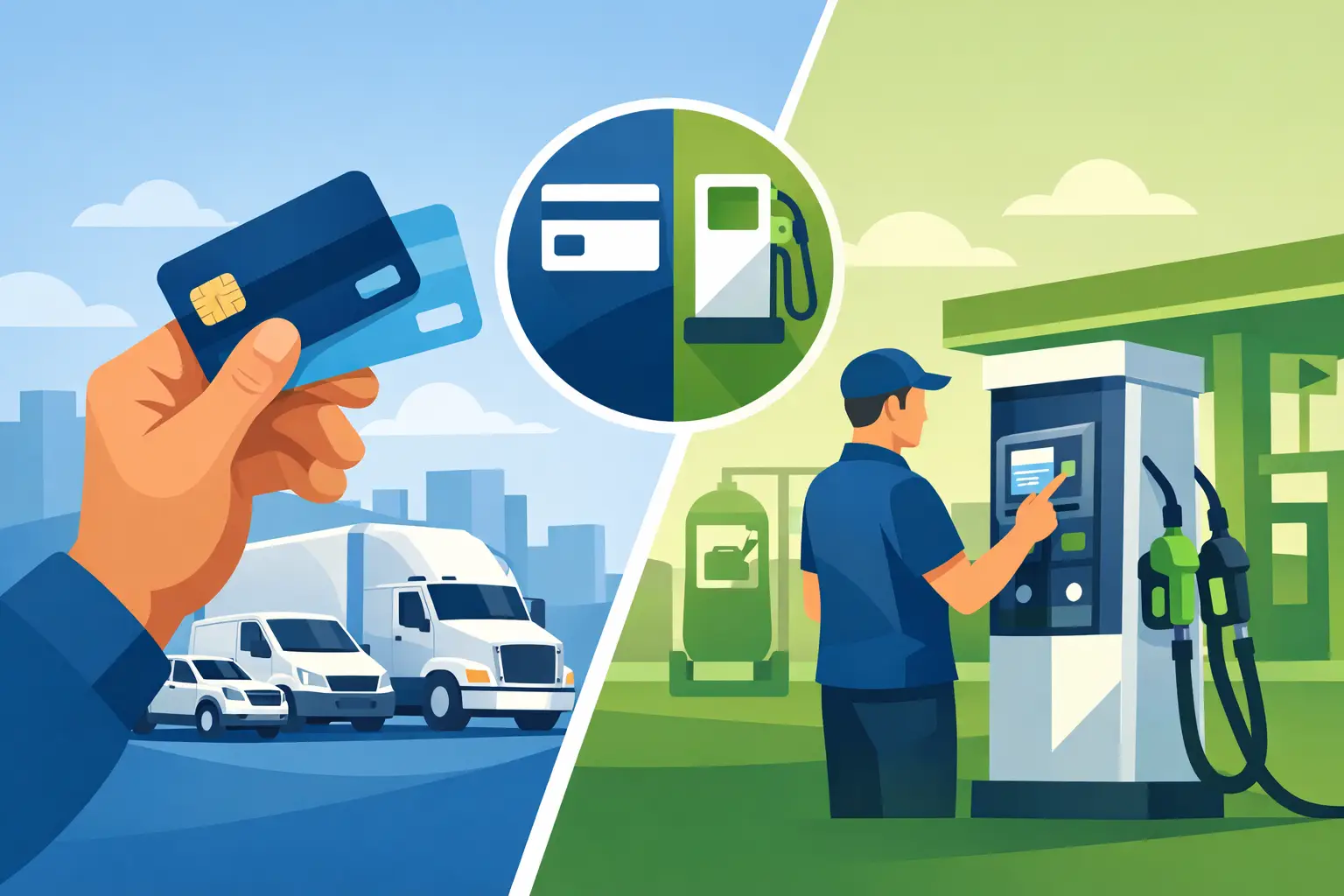
Fleet cards are built to pay for fuel bought from third-party retail sites. They can give you spend visibility, merchant controls, and some driver-level reporting. They are useful when vehicles refuel away from base and you need a cleaner alternative to cash, petty expenses, or personal cards.
Pump control solves a different problem. It controls access to your own fuel or fluid assets, whether that is a static tank in a yard, a bowser, or a mobile refuelling unit. Instead of simply recording a purchase, it authorises the dispense itself, links it to an approved user, and creates a transaction record at the moment fuel leaves your tank.
That distinction matters. A fleet card tells you someone bought fuel. Pump control tells you who was allowed to draw fuel, when they did it, from which asset, and how much left your inventory.
Why the comparison matters more for private fuelling
Many fleet operators start with cards because they are easy to issue and familiar to finance teams. But as soon as you are storing fuel on-site, the control gap becomes obvious. A card programme cannot lock a pump. It cannot stop unauthorised access to a site tank. It cannot always tell you whether a dispense went into the right vehicle, or any vehicle at all.
That is where losses hide. Sometimes it is outright theft. Sometimes it is poor discipline, shared PINs, handwritten logs, or delayed data that makes reconciliation harder than it should be. In each case, the cost is not limited to fuel. It spreads into administration time, stock variances, compliance risk, and reduced confidence in the numbers your team is working from.
For operators with private fuelling, pump control is usually the stronger control layer because it deals with the point of issue, not just the point of payment.
Where fleet cards perform well
Fleet cards still have a clear role. If your drivers regularly buy fuel on the road, cards remain practical. They help centralise billing, remove expense claims, and can limit purchases by merchant type, product category, or transaction value.
They also suit dispersed fleets that do not have enough volume at a home depot to justify on-site storage. A service fleet travelling across regions may get more value from broad network access than from fixed-site infrastructure. In that case, the card is not a compromise. It is the right tool.
Even for mixed operations, cards can support resilience. If a site tank is temporarily offline or a vehicle is operating beyond its normal route, a card gives drivers a fallback without dismantling your wider fuel policy.
The limitation is simple: a fleet card is strongest as a payment and reporting product. It is weaker as a physical control system.
Where pump control changes the economics
Pump control becomes far more compelling when you own the fuel, operate fixed or mobile tanks, or need tighter accountability by driver, vehicle, and asset. In those settings, preventing one unauthorised dispense can matter more than negotiating a few pence off a retail litre price.
The financial case usually rests on four areas. First, loss reduction. If only authorised people can dispense, and every transaction is logged automatically, shrinkage becomes harder to hide. Second, labour savings. Manual logbooks, spreadsheet reconciliation, and after-the-fact detective work all fall away. Third, inventory confidence. Knowing what left the tank and when makes stock management much cleaner. Fourth, lower maintenance and hardware burden if the system is modern and cloud-connected rather than heavily dependent on legacy pedestal infrastructure.
This is why many operators stop treating pump control as a nice extra and start treating it as part of core fleet governance.
Auditability is where the gap widens
Finance teams and controllers tend to look at this issue differently from operations. They want a reliable audit trail. They want to reconcile spend to usage, identify exceptions quickly, and close periods without chasing missing records.
Fleet cards provide transactional data, but that data starts after a retail purchase has happened. With pump control, the audit trail begins at authorisation. That means the system can record the user, the site, the asset, the time, and the dispense volume in real time. For businesses under pressure to tighten internal controls, that is a significant difference.
It also changes response time. If a user leaves the business or changes role, access can be withdrawn immediately. You are not waiting for cards to be recovered, PINs to be changed informally, or old habits to die out.
Fleet cards vs pump control on security and misuse
Security is where there is least room for vague thinking. If fuel is stored on your premises or in a mobile refuelling unit, it is an asset that needs the same discipline as keys, stock, or controlled parts.
A card can be lost, shared, or used in ways that are technically against policy but difficult to police in practice. Most providers offer controls, but those controls still sit around transactions at external sites. They do not physically secure your tank.
Pump control is more direct. It restricts access before fuel flows. If the system uses individual user authorisation and cloud-based permissions, managers can control dispensing rights centrally across sites and change them instantly. That is a stronger position than relying on handwritten sign-out sheets or generic codes known by half the depot.
Of course, security is only as good as the discipline around it. If user identities are shared or asset data is badly maintained, any system loses value. But pump control gives you the framework to enforce accountability consistently.
The best choice may be both
This is not always an either-or decision. Many fleets need both, because their fuelling pattern is mixed. Vehicles may refuel from a depot tank during the week and use retail stations for remote jobs, long routes, or emergency top-ups.
In that model, fleet cards handle external purchases while pump control secures private dispensing. The result is a more complete fuel strategy: controlled access on-site, proper audit trails for your own inventory, and managed spend when drivers are away from base.
That blended approach often works best for growing fleets. It lets you tighten internal controls without limiting operational flexibility. It also gives finance, maintenance, and operations teams a cleaner line of sight into total fuel activity rather than forcing one tool to do a job it was never designed to do.
How to decide what fits your operation
The right decision depends on your risk profile more than your fleet size. If you do not own fuel assets and buy almost everything from public stations, fleet cards may be enough. If you store fuel on-site, run mobile tanks, or struggle with stock variances and weak reconciliation, pump control deserves serious attention.
Ask practical questions. Where does most fuel actually enter vehicles? How often do you investigate unexplained losses? How much admin time goes into matching litres to users, jobs, or vehicles? How quickly can you revoke access today? If those answers expose gaps, the issue is not convenience. It is control.
This is also where total cost of ownership matters. A cheaper-looking process can become expensive when you account for losses, manual work, and ageing hardware. Modern pump control systems can reduce complexity as well as tighten security, particularly when they are simpler to install, easier to update, and designed for both fixed and mobile sites. That is why operators looking for complete accountability at the pump often move beyond cards alone and towards solutions such as those supplied by Manage Every Drop.
The strongest fuel management setup is the one that matches how your fleet actually works, not how your reports wish it worked. If fuel is one of your largest controllable costs, every dispense should be authorised, visible, and easy to defend.


Post a comment